

Key takeaways
- PCOS-related hair loss is female pattern hair loss with an identifiable androgen driver — clinically indistinguishable from the far more common version where androgens are normal.
- The 2023 international guideline states that female pattern hair loss and acne alone are relatively weak predictors of biochemical hyperandrogenism, while hirsutism alone is predictive.
- There is no NICE guideline for PCOS; UK practice follows the 2023 International Evidence-based PCOS Guideline.
- Topical minoxidil is the only licensed treatment for female androgenetic alopecia in the UK, licensed for women aged 18 to 65.
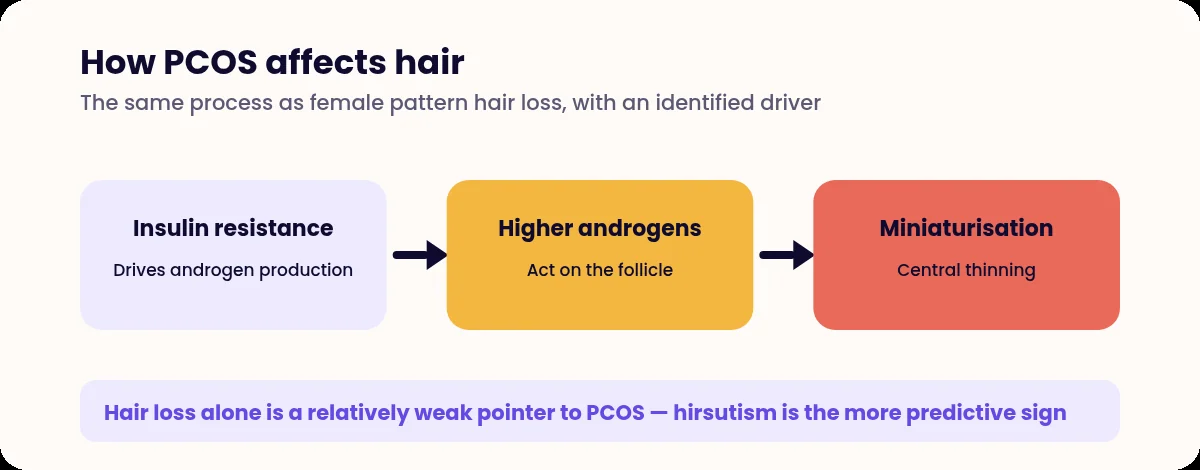
Polycystic ovary syndrome causes hair loss through androgen excess. Higher circulating androgens act on follicles in the androgen-sensitive areas of the scalp, and those follicles miniaturise — each growth cycle produces a shorter, finer, less pigmented hair, until it no longer reaches the surface in a meaningful way.
The important thing to understand first is that this produces a picture clinically indistinguishable from ordinary female pattern hair loss. PCOS-related loss is female pattern hair loss, with an identifiable driver. And most female pattern hair loss occurs in women with entirely normal androgen levels.
What the pattern looks like
Diffuse thinning through the centre and vertex with a preserved frontal hairline, described on the Ludwig or Sinclair scales [5]. Most women notice it as a widening central parting rather than as a receding anything — the parting that used to be a line becomes a strip, and it is most obvious in photographs taken from above or in bright overhead light.
Bitemporal recession is uncommon in this pattern, and when it is present it should prompt review rather than being folded into the diagnosis [5]. Recession at the temples in a woman is a reason for a clinician to look harder, not a confirmation.
The nuance that changes who gets tested
This is the single most important point on the page, and it runs against how hair loss is usually discussed.
UK assessment of PCOS anchors on the 2023 International Evidence-based PCOS Guideline [1] — and it is worth knowing that there is no NICE guideline for PCOS, which is why UK clinicians work from an international document rather than a domestic one.
That guideline states, in recommendation 1.3.2, that female pattern hair loss and acne alone are relatively weak predictors of biochemical hyperandrogenism [1]. By contrast, recommendation 1.3.1 holds that hirsutism alone is predictive [1].
In plain terms: hair loss on its own is a poor pointer to PCOS. Unwanted coarse hair growth in a male-pattern distribution is a good one. If hair thinning is your only feature, the prior probability that androgen testing will find something is lower than the internet suggests, and a normal result should not feel like a dead end — it is the expected result.
What raises suspicion properly is the combination: thinning plus hirsutism, irregular or absent periods, difficulty conceiving, or acne that persists well beyond adolescence.
What the testing involves
If androgen excess is being assessed, the guideline is specific [1]:
- Total and free testosterone, with free testosterone estimated via a calculated free androgen index (recommendation 1.2.1).
- If those are normal and suspicion persists, androstenedione and DHEAS may be considered, with the explicit caveat that both have poorer specificity (1.2.2).
- Assays should be LC-MS/MS, not direct immunoassays (1.2.3). This is a real-world problem: direct immunoassays perform badly at the low testosterone concentrations found in women, and a result from one is less informative than the number suggests.
- Hirsutism is scored using the modified Ferriman-Gallwey scale with a cut-off of 4 to 6, which is ethnicity-dependent (1.3.5).
- Anti-Müllerian hormone may be used to define polycystic ovarian morphology in adults but not as a single diagnostic test, and not in adolescents (1.5.1, 1.5.3, 1.5.4).
UK practice around that core usually adds thyroid function, ferritin and prolactin, because all three cause overlapping presentations, and 17-hydroxyprogesterone where non-classical congenital adrenal hyperplasia needs excluding. Our guide to hair loss blood tests covers what each one is actually for, and hair loss and thyroid disease covers the commonest overlapping cause.
Treatment and licensing in the UK
This is where accuracy matters most, because the gap between what is used and what is licensed is unusually wide.
Topical minoxidil is the only licensed treatment for female androgenetic alopecia in the UK [3]. Regaine for Women Regular Strength 2% solution and Regaine for Women Once a Day Scalp Foam 5% are both licensed for women aged 18 to 65, and both are pharmacy medicines. That single sentence is the whole licensed landscape for this indication in women. Our guide to minoxidil explained covers how it is used and what to expect.
Everything else is a prescriber decision made outside the licence, and the detail is worth knowing before a consultation:
- Combined oral contraceptives are generally first line for androgenic features in PCOS, but they are not licensed for hair loss — use for alopecia is off-label [1].
- Co-cyprindiol (cyproterone acetate with ethinylestradiol) is licensed for severe acne and hirsutism, not for alopecia. The MHRA restricts cyproterone use because of a dose- and duration-dependent meningioma risk [4].
- Spironolactone’s UK licensed indications are congestive cardiac failure, hepatic cirrhosis with ascites, malignant ascites, nephrotic syndrome and primary aldosteronism only [6]. Its use for female pattern hair loss and hirsutism is off-label. It is widely used for this in the UK and the US alike, typically at 50 to 200mg daily, and it requires reliable contraception and monitoring of kidney function and electrolytes. There is no UK licence for it in hair loss, and it is a prescription only medicine.
- Finasteride and dutasteride are contraindicated in women of childbearing potential, and finasteride 1mg product information states that it is not indicated for use in women [1]. Any use in women is off-label and specialist territory.
- Metformin is used for metabolic features. There is no evidence that it treats hair loss [1].
None of the above is a recommendation. It is the licensing landscape, so that when a prescriber proposes something you can ask the right question — is this licensed for what we are treating, and if not, what is the evidence and what is the monitoring?
Where weight fits
PCOS, insulin resistance and androgen levels interact, and weight change affects all three. That is genuinely relevant, and it is also frequently overstated in a way that makes women feel their hair is their own fault. Improving metabolic features is worth doing for its own reasons; expecting it to reverse miniaturised follicles is expecting too much of it. Our guide to PCOS and weight covers that relationship properly.
For the shape and course of the hair loss itself, including what realistic improvement looks like and how long it takes to see, female pattern hair loss is the fuller read.
Frequently asked questions
Does hair thinning mean I have PCOS?
Usually not. Female pattern hair loss is common and most of it occurs with entirely normal androgen levels. The 2023 international guideline specifically notes that hair loss and acne alone are relatively weak predictors of biochemical hyperandrogenism. Unwanted coarse hair growth in a male pattern — hirsutism — is a much stronger pointer, and so are irregular or absent periods.
What blood tests are used to look for androgen excess?
The guideline recommends total and free testosterone, with free testosterone estimated through a calculated free androgen index, measured by LC-MS/MS rather than direct immunoassay. If those are normal and suspicion remains, androstenedione and DHEAS can be considered, though both have poorer specificity. UK practice usually adds thyroid function, ferritin and prolactin because they cause overlapping symptoms.
What does PCOS hair loss look like?
Diffuse thinning through the centre and crown with a preserved frontal hairline, seen most obviously as a widening central parting. Recession at the temples is uncommon in female pattern hair loss and should prompt a clinician to look for another explanation rather than being assumed to be part of the picture.
Will metformin help my hair?
There is no evidence that metformin treats hair loss. It is used in PCOS for metabolic features, and improving those is worthwhile in its own right, but it should not be taken on the expectation of hair regrowth.
References
- Teede HJ et al. Recommendations from the 2023 International Evidence-based Guideline for the Assessment and Management of Polycystic Ovary Syndrome. Journal of Clinical Endocrinology and Metabolism, 2023;108:2447. academic.oup.com/jcem/article/108/10/2447/7241238
- NHS. Polycystic ovary syndrome. www.nhs.uk/conditions/polycystic-ovary-syndrome-pcos/
- Summary of Product Characteristics: Regaine for Women Once a Day Scalp Foam 5% w/w. Electronic Medicines Compendium. www.medicines.org.uk/emc/
- MHRA. Cyproterone acetate: new advice to minimise risk of meningioma. Drug Safety Update. www.gov.uk/drug-safety-update
- DermNet. Female pattern hair loss. dermnetnz.org/topics/female-pattern-hair-loss
- British National Formulary. Spironolactone. bnf.nice.org.uk/drugs/spironolactone/
Medical reviewer
Naeem Teni
Clinical Lead at Manova. Registered pharmacist and independent prescriber, GPhC 2215591. Reviews Manova’s clinical content for accuracy and safety.
Written by
Manova Editorial Team
Researched and written to our editorial policy, using NICE, NHS, MHRA and peer-reviewed sources.
This article is for general information and isn’t a substitute for advice from your own clinician. If you feel unwell, contact your GP or NHS 111. In an emergency, call 999.