

Key takeaways
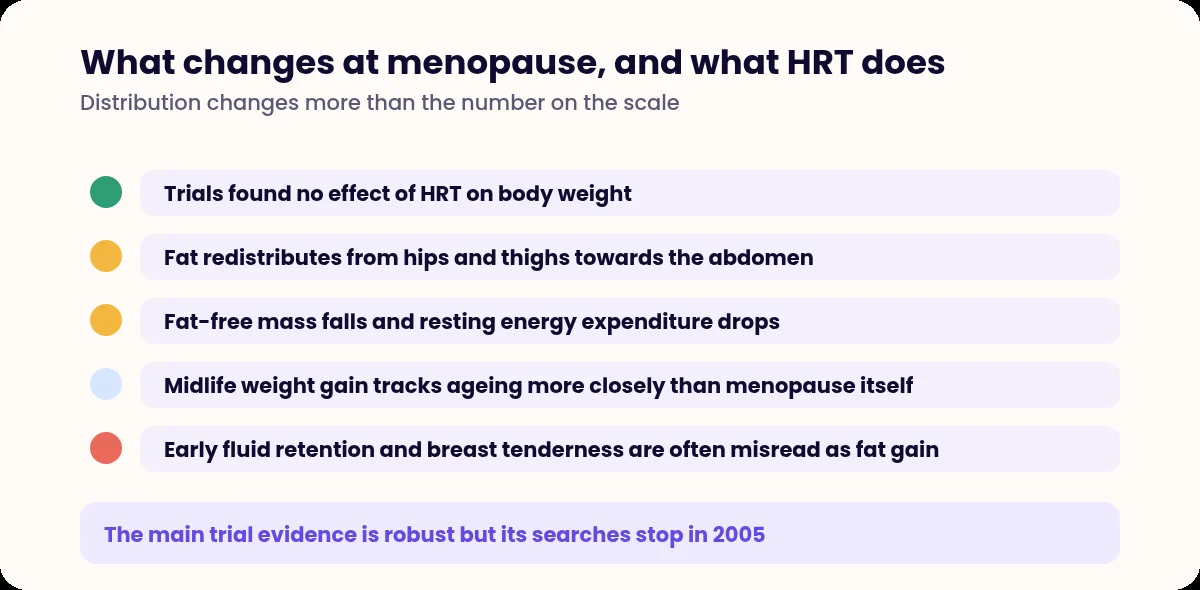
- A Cochrane review of 28 randomised trials in 28,559 women found no evidence that HRT affects body weight, with differences of well under half a kilogram.
- That review is robust but dated: its searches stop at July 2005, so it does not cover newer preparations or transdermal routes in the same detail.
- Midlife weight gain tracks chronological ageing at roughly 0.5 kg a year; what menopause changes is where fat is stored and how much fat-free mass is retained.
- Fluid retention and breast tenderness in the first weeks of HRT are common and are frequently misread as fat gain.
The question gets asked constantly, and the trial evidence gives an unusually clean answer: HRT does not appear to cause weight gain. The reason so many women are convinced otherwise is that something else is happening to the body at the same time, and HRT is often started right in the middle of it.
Separating those two things is most of what this article is for.
What the trials found
A Cochrane review pooled 28 randomised controlled trials covering 28,559 women [1]. Comparing hormone therapy with placebo:
- Unopposed oestrogen: weight difference 0.03 kg (95% CI -0.61 to 0.67)
- Oestrogen plus progestogen: weight difference 0.04 kg (-0.42 to 0.50)
Both estimates sit essentially at zero, and the confidence intervals are narrow enough to exclude any clinically meaningful effect in either direction. The review’s conclusion was that there is no evidence of an effect on body weight.
One important limitation, which is rarely mentioned when this review is cited. It was published in 2000 and its searches run only to July 2005. Prescribing has moved on considerably since then, particularly towards transdermal oestrogen and micronised progesterone, which are now common in UK practice. The review’s finding is robust for the preparations it covered. It is not a current assessment of every regimen in use today, and nobody should pretend otherwise.
That said, no substantial body of newer evidence has overturned it, and the mechanistic case for HRT causing fat gain was never strong.
What actually changes at midlife
Here is the part that gets attributed to HRT and belongs elsewhere.
Total weight gain in midlife tracks chronological ageing rather than menopause itself. Cohort data put it at roughly 0.5 kg a year through this period, and that trajectory is present in women who do not go through menopause at the expected time as well.
What menopause changes is fat distribution and body composition [2]:
- A shift from gluteofemoral storage (hips and thighs) towards visceral and central fat
- A fall in fat-free mass
- A reduction in resting energy expenditure, partly as a consequence of that lost lean tissue
This combination explains a great deal of the lived experience. The number on the scales may barely move while clothes fit differently and the waist changes shape. And because resting expenditure falls, an unchanged diet becomes a small surplus without anything having gone wrong.
Visceral fat carries more metabolic risk than subcutaneous fat, which is why waist measurement is more informative than BMI at this stage of life. Visceral fat and waist-to-height ratio cover the measurement side.
The first few weeks
A large share of the belief that HRT causes weight gain is formed in the first month of taking it.
Fluid retention and breast tenderness are common early effects, and both are frequently misread as fat gain. Fluid can move the scales by a kilogram or two and produce a genuine feeling of bloating and tightness. Fat gain of that magnitude in two weeks would require an enormous energy surplus, which is a useful sanity check.
These effects usually settle. The practical consequence of not knowing that is that some women stop HRT early, attributing to it a change that would have resolved. If early side effects are troubling, the thing to do is raise it with your prescriber rather than stop.
Does HRT help with central fat
Some evidence suggests HRT may attenuate central fat accumulation across the menopausal transition. That is an interesting observation and it is not an indication for prescribing. HRT is prescribed for menopausal symptoms after an individualised discussion of benefits and risks, not for body composition.
NICE NG23 was updated in November 2024 [3]. The update emphasises individualised care and shared decision-making, recommends CBT for vasomotor symptoms alongside or instead of HRT, states that HRT is unlikely to increase or decrease overall life expectancy, and says HRT should not be offered to prevent cardiovascular disease or dementia. A new discussion aid was published alongside it.
What NG23 does not do is make any weight-related recommendation about HRT. If you see a claim that NICE endorses HRT for weight or body composition, it is wrong.
What does work in midlife
The interventions with the best evidence at this stage are unglamorous and mostly about protecting lean tissue.
Resistance training. The fall in fat-free mass is the driver of the fall in resting expenditure, and progressive resistance training is the only intervention that reliably opposes it. See strength training over 40.
Protein intake at the upper end. Around 1.2 to 1.6 g per kg per day while losing weight, for the same reason.
Sleep. Vasomotor symptoms disrupt sleep, and disrupted sleep makes appetite regulation and adherence harder. Treating the symptoms often helps the behaviour indirectly.
Judging progress by waist as well as weight, given that the distribution change is the part menopause is actually responsible for.
The broader picture is in menopause and weight.
Why the perception persists anyway
It is worth naming why the belief is so durable despite the trial data. HRT is usually started in the years when midlife weight gain, the fall in lean mass and the redistribution of fat are all happening anyway. Anything begun in that window will be credited with the changes that follow it. Add a genuine early fluid effect, and the association becomes very hard to unlearn from personal experience alone.
This is exactly the situation randomised trials exist to resolve, because they compare women taking HRT with otherwise similar women who are ageing at the same rate and are not. When you do that comparison, the difference in weight disappears.
If you are considering weight loss medicines as well
Weight loss medicines are prescription treatments assessed on BMI and comorbidity criteria, not on menopausal status, and being on HRT is not in itself a barrier. Eligibility and what an assessment involves are covered in weight loss medication eligibility in the UK.
When to speak to a clinician
- Any bleeding after the menopause — this needs assessment, arrange a GP appointment promptly
- Weight gain that is rapid or unexplained, or accompanied by swelling of the legs or breathlessness
- Troublesome HRT side effects — raise them with your prescriber rather than stopping
- Unexplained weight loss at any age
Frequently asked questions
Does HRT make you put on weight?
Randomised trial evidence says no. A Cochrane review of 28 trials found a difference of 0.03 kg for oestrogen alone and 0.04 kg for oestrogen plus progestogen versus placebo, both well within the margin of error. The weight gain many women experience around this time is real, but it is not attributable to HRT in the trial data.
Why do I feel heavier after starting HRT?
Fluid retention and breast tenderness are common in the first weeks and can add a kilogram or two on the scales along with a bloated feeling. Both usually settle. It is a fluid and tissue effect rather than fat gain, and it is one of the most common reasons women stop early.
Does menopause cause belly fat?
Menopause is associated with a shift in fat storage from hips and thighs towards the abdomen, along with a fall in fat-free mass and a lower resting energy expenditure. Total weight gain in midlife tracks ageing more than menopause itself, but the change in distribution is genuinely menopause-related.
Will HRT help me lose weight?
It is not a weight loss treatment and should not be prescribed as one. Some evidence suggests HRT may lessen central fat accumulation, but that is not an indication for prescribing, and NICE guidance makes no weight-related recommendation about HRT.
References
- Norman RJ, Flight IHK, Rees MCP. Oestrogen and progestogen hormone replacement therapy for peri-menopausal and post-menopausal women: weight and body fat distribution. Cochrane Database of Systematic Reviews. CD001018. doi.org/10.1002/14651858.CD001018
- Lovejoy JC, et al. Increased visceral fat and decreased energy expenditure during the menopausal transition. International Journal of Obesity. doi.org/10.1038/ijo.2008.25
- NICE. Menopause: identification and management. NG23. Updated November 2024. www.nice.org.uk/guidance/ng23
- NHS. Hormone replacement therapy (HRT). www.nhs.uk/medicines/hormone-replacement-therapy-hrt/
Medical reviewer
Naeem Teni
Clinical Lead at Manova. Registered pharmacist and independent prescriber, GPhC 2215591. Reviews Manova’s clinical content for accuracy and safety.
Written by
Manova Editorial Team
Researched and written to our editorial policy, using NICE, NHS, MHRA and peer-reviewed sources.
This article is for general information and isn’t a substitute for advice from your own clinician. If you feel unwell, contact your GP or NHS 111. In an emergency, call 999.