

Key takeaways
- Drinking 500 mL of water before each meal produced about 44% more weight loss in a 12-week trial, but the participants were aged 55 to 75.
- The mechanism is almost certainly gastric distension reducing intake at that meal, and the effect is smaller or absent in younger adults.
- Warming 500 mL of cold water to body temperature costs roughly 8 to 10 kcal, which is nutritionally irrelevant.
- NHS advice is 6 to 8 glasses of fluid a day including tea, coffee and lower-fat milk, which is not the same as the US figures often quoted.
Hydration is the area of weight loss advice where the ratio of confident claims to actual evidence is highest. Some of it holds up. Most of it does not, and one piece of it is genuinely useful in a way that has nothing to do with water itself.
What the trials found
A systematic review published in JAMA Network Open in November 2024 pulled together 18 randomised trials of increased daily water intake, published between 1999 and 2023, with a median sample size of 48. Only half were rated at low risk of bias [1]. That is a small, uneven evidence base, and it should temper everything that follows.
On weight, four studies: three adult trials found pre-meal water produced greater weight loss, ranging from 44% to 100% more than control. One trial in adolescents found no benefit.
On kidney stones, two studies found 15 fewer stone events per 100 participants over five years. On urinary tract infections, one trial found an extra 1,500 mL a day substantially reduced episodes over 12 months in women.
The authors’ own conclusion is appropriately hedged: while the quality and quantity of evidence is limited, a small number of studies suggested benefits of water intake on weight loss and kidney stones.
The pre-meal water finding, and its limits
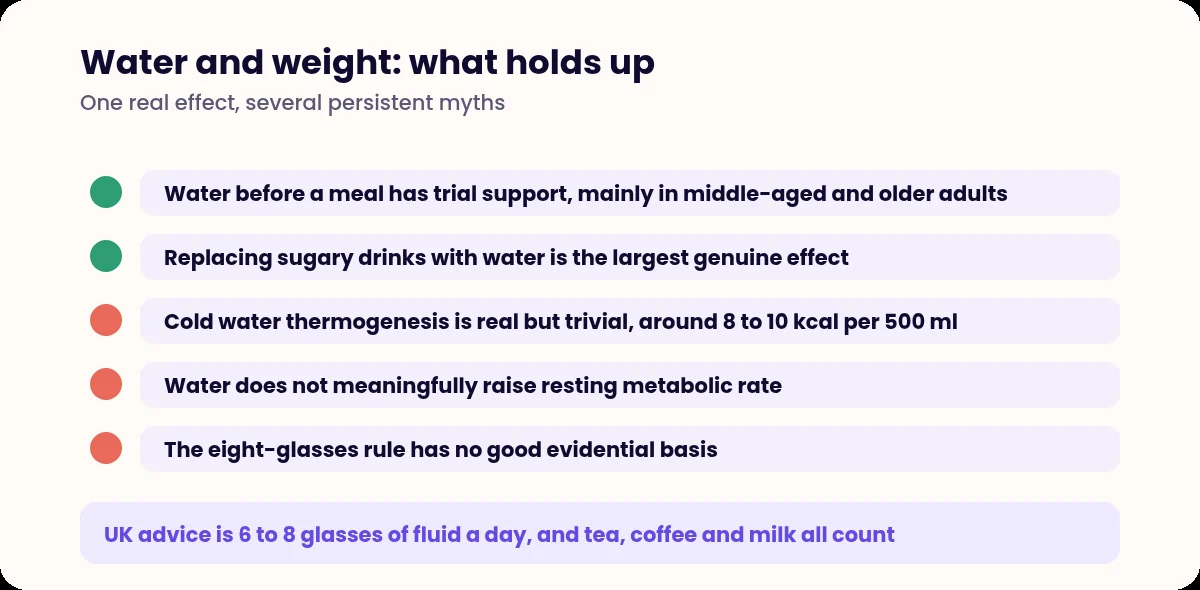
The most-cited trial is Dennis and colleagues, 2010 [2]. Forty-eight adults aged 55 to 75 on a reduced-calorie diet were randomised to drink 500 mL of water before each of three meals or not. Over 12 weeks, the water group lost approximately 44% more weight, a statistically significant difference.
That is a real randomised finding and it is why the advice keeps being repeated. Two caveats change how you should apply it.
The mechanism is mechanical, not metabolic. Half a litre of water in the stomach before eating distends it and reduces how much is eaten at that meal. Nothing about water is doing anything clever to fat metabolism. It is a volume trick, and it works the same way that a bowl of soup or a large salad before a main course works.
It has mainly been demonstrated in middle-aged and older adults. In younger adults the effect is smaller or absent, because gastric emptying is faster and the satiety signal from distension is weaker. The one trial in adolescents found nothing. If you are 28 and drinking two pints of water before dinner on the strength of a trial in over-55s, you are probably not getting the trial’s result.
None of which is an argument against doing it. It costs nothing, the downside is limited to inconvenience, and if it reduces your intake it reduces your intake. Just do not expect it to carry a plan on its own. Volume-based fullness is more reliably achieved through fibre and sensible portion sizes, which work at every age.
The claims that do not hold up
“Cold water burns significant calories.” Warming 500 mL of water from around 22°C to body temperature costs roughly 8 to 10 kcal. The thermogenic effect is real — it is basic thermodynamics — and it is nutritionally irrelevant. You would need to drink an implausible volume of iced water daily to reach the energy content of a biscuit.
“Water boosts your metabolism.” There is no meaningful sustained effect on resting metabolic rate. The short-lived bumps reported in small studies do not add up to anything over a day.
“You must drink eight glasses, or two litres, a day.” This figure has no good evidential basis. It is one of the most durable numbers in health advice and nobody can point to the study.
The UK position is different from the US one, and the difference is the source of most confusion. The NHS Eatwell Guide advises 6 to 8 glasses of fluid a day, around 1.2 litres, and explicitly counts tea, coffee, lower-fat milk and sugar-free drinks toward that total [3, 4]. Higher US figures generally refer to total water intake including water contained in food, which is a different quantity entirely — and it is routinely misquoted as plain drinking water on top of everything else. If you are drinking tea all day, you are hydrating.
“Thirst is often mistaken for hunger.” Extremely widely repeated, poorly evidenced in humans. Thirst and hunger are distinct signals. Drinking a glass of water and waiting ten minutes does no harm as a habit, but it is a behavioural pause rather than a correction of a confused signal. Several claims in this territory are covered in weight loss myths.
The part that genuinely works
Replacing sugar-sweetened drinks with water reliably reduces energy intake. This is by a distance the largest real hydration-related weight effect, and it is about displacement, not about water.
A person drinking a litre of sugar-sweetened soft drink a day is taking in several hundred calories that produce almost no fullness. Liquid calories are poorly compensated for at subsequent meals. Swapping that for water, or unsweetened tea or coffee, removes the calories without removing any food.
The same logic applies to alcohol, which is calorie-dense, poorly compensated for and tends to increase intake afterwards — covered in alcohol and weight.
So the honest ranking of hydration advice by usefulness:
- Replace sugar-sweetened drinks and reduce alcohol. Large, reliable effect.
- Drink water before meals if it helps you eat less, particularly if you are over 50. Modest, plausible effect.
- Drink enough to avoid dehydration, using the 6 to 8 glasses guide including tea and coffee. Not a weight intervention, just sensible.
- Ignore the thermogenesis and metabolism claims entirely.
If you are taking a weight loss medicine
Fluid intake becomes a clinical matter rather than a weight strategy.
Nausea, vomiting and diarrhoea are common effects, particularly during dose escalation, and they raise the risk of dehydration and of acute kidney injury. UK product information advises attention to fluid intake for this reason. Reduced appetite also means people drink less simply because they are eating and thinking about food less.
Practical version: keep fluids going even when you do not feel like it, take them in small frequent amounts if nausea is a problem, and treat reduced urine output, dark urine, dizziness on standing or persistent vomiting as a reason to seek advice rather than push through [5]. Managing the digestive effects is covered in nausea on weight loss medicines.
There is no need to drink large volumes beyond normal requirements on these medicines. The goal is not to be under-hydrated, not to be extra-hydrated.
When to speak to a clinician
Get medical advice if you:
- have persistent vomiting or diarrhoea and cannot keep fluids down — this needs same-day assessment
- notice much reduced urine output, very dark urine, dizziness on standing or confusion, which may indicate significant dehydration
- have heart failure or kidney disease, where fluid intake may need to be limited rather than increased and you should not change intake substantially without advice
- take diuretics, lithium or other medicines where fluid balance affects drug levels
- are drinking very large volumes of water, which can dilute blood sodium and is dangerous in excess
Frequently asked questions
Does drinking water before meals help you lose weight?
There is randomised evidence that it can. In a 12-week trial, 48 adults aged 55 to 75 on a reduced-calorie diet who drank 500 mL of water before each of three meals lost about 44% more weight than those who did not. The effect is most likely gastric distension reducing how much is eaten at that meal, and it has mainly been shown in middle-aged and older adults.
How much water should I drink a day?
NHS guidance is 6 to 8 glasses of fluid a day, around 1.2 litres, and it explicitly counts tea, coffee, lower-fat milk and sugar-free drinks toward that total. Higher figures from US sources usually refer to total water including what comes from food, and get misquoted as plain drinking water.
Does cold water burn calories?
A negligible amount. Warming 500 mL of water from room temperature to body temperature costs roughly 8 to 10 kcal. That is real physics and nutritionally irrelevant. Claims that water meaningfully boosts metabolism are not supported by any sustained effect on resting metabolic rate.
Can thirst be mistaken for hunger?
It is a very widely repeated idea and poorly evidenced in humans. Thirst and hunger are distinct signals with distinct physiology. Drinking a glass of water before deciding whether you are hungry does no harm, but the claim that people routinely confuse the two should not be treated as established.
References
- Systematic review of randomised trials of increased water intake and health outcomes. JAMA Network Open. November 2024. jamanetwork.com/journals/jamanetworkopen
- Dennis EA, Dengo AL, Comber DL, et al. Water consumption increases weight loss during a hypocaloric diet intervention in middle-aged and older adults. Obesity. 2010;18(2):300-307. doi.org/10.1038/oby.2009.235
- NHS. Water, drinks and your health. www.nhs.uk/live-well/eat-well/food-guidelines-and-food-labels/water-dr
- NHS. The Eatwell Guide. www.nhs.uk/live-well/eat-well/food-guidelines-and-food-labels/the-eatw
- NHS. Dehydration. www.nhs.uk/conditions/dehydration/
Medical reviewer
Naeem Teni
Clinical Lead at Manova. Registered pharmacist and independent prescriber, GPhC 2215591. Reviews Manova’s clinical content for accuracy and safety.
Written by
Manova Editorial Team
Researched and written to our editorial policy, using NICE, NHS, MHRA and peer-reviewed sources.
This article is for general information and isn’t a substitute for advice from your own clinician. If you feel unwell, contact your GP or NHS 111. In an emergency, call 999.