

Key takeaways
- Total daily protein is the dominant variable; how it is spread across the day is a secondary refinement with weak supporting evidence.
- A 2020 systematic review found convincing evidence lacking either to support or refute the idea that even distribution is better.
- Per-meal doses of around 25-30 g suit younger adults, with roughly 40 g often cited for older adults because of anabolic resistance.
- The UK Reference Nutrient Intake of 0.75 g/kg/day is notably lower than international recommendations for older adults and has not been updated.
Protein timing is one of those subjects where the confidence of the advice is inversely proportional to the strength of the evidence. The honest summary fits in a sentence: hit your daily total, and spread it across the day in whatever way you will actually keep doing.
Everything beyond that is refinement, and the refinements are less well supported than they sound.
Total first, and it is not close
Across the literature, total daily protein intake is the dominant variable for preserving or building muscle. Distribution is a secondary factor.
A 2020 systematic review looked specifically at whether spreading protein evenly across meals beats an uneven pattern [1]. Of five acute randomised trials, one supported balanced distribution and four were null. Of five chronic trials, one supported balanced distribution, three were null, and one actually favoured the unbalanced pattern. The authors’ conclusion was that convincing evidence is lacking to support or refute the hypothesis.
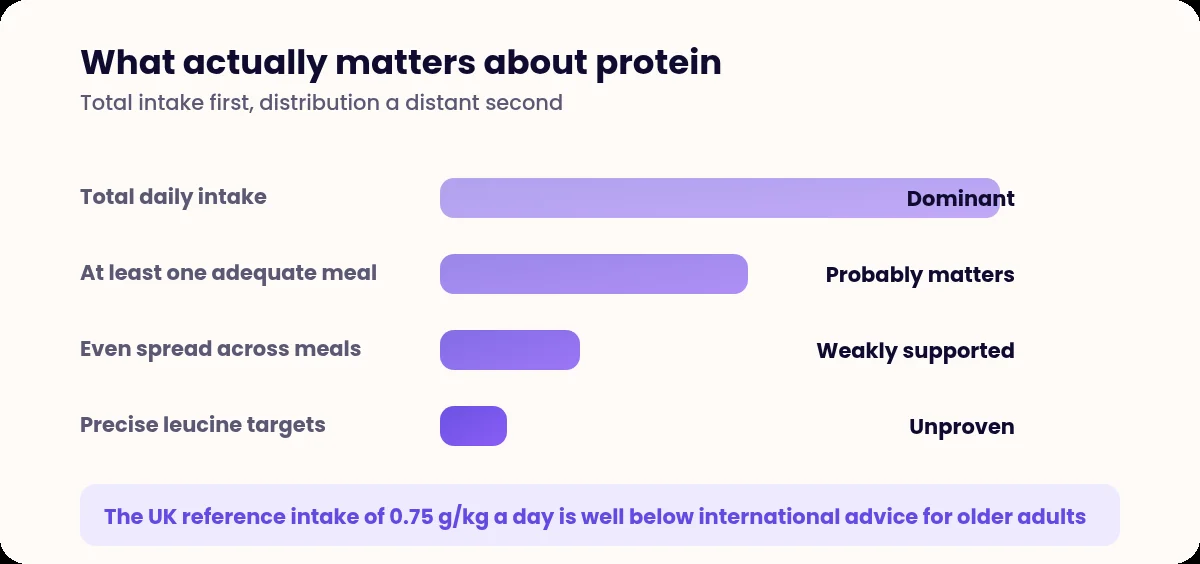
That is not the same as saying distribution is irrelevant. It is saying that if there is an effect, it is small enough that studies of this size cannot reliably see it. For someone trying to decide what to do at breakfast, “probably small” is the useful answer.
The numbers people quote
Even though the distribution evidence is weak, the per-meal figures are worth knowing, because they are a reasonable planning heuristic.
- Younger adults: roughly 25-30 g of high-quality protein per meal
- Older adults: roughly 40 g, around 70% higher
- Relative dose: approximately 0.3-0.4 g per kg of body weight per meal
The higher figure for older adults reflects anabolic resistance — muscle becomes less responsive to a given dose of protein with age, so more is needed to produce the same response. That is one of the better established observations in this area.
The leucine threshold
You will also encounter the idea that each meal needs around 2.5 to 3 g of leucine to trigger muscle protein synthesis. This comes from acute isotope-tracer studies in small samples. It is mechanistically plausible and it has not been shown to translate into superior long-term lean mass outcomes.
Treat it as a laboratory finding that has not yet earned clinical status. In practice, a normal 25 to 40 g serving of most animal protein or a well-constructed plant combination clears the threshold anyway, so it rarely changes what anyone should eat.
Daily totals worth aiming at
During weight loss: commonly cited at 1.2 to 1.6 g per kg of body weight per day, and up to around 2.4 g/kg in lean, trained individuals in a deficit. This matters more than timing because a deficit is exactly when muscle is at risk. See losing weight without losing muscle.
Older adults: the PROT-AGE position paper recommends 1.0 to 1.2 g/kg/day for healthy older people, 1.2 to 1.5 with acute or chronic illness, and up to 2.0 in severe illness [2]. ESPEN gives similar figures: 1.0 to 1.2 healthy, 1.2 to 1.5 where malnourished or at risk.
The UK number is the outlier
This is the part UK readers most need, and it is missing from almost all international material.
The UK Reference Nutrient Intake for protein is 0.75 g per kg of body weight per day, set by COMA in 1991 [3]. The EU population reference intake is 0.83 g/kg/day.
For a 70 kg adult, 0.75 g/kg is about 53 g a day. The PROT-AGE figure for a healthy 70 kg older adult is 70 to 84 g. That is a substantial gap, and it exists because the two numbers are answering different questions. The RNI is a population figure designed to cover the requirements of most healthy adults and prevent deficiency. It was never intended as an optimum for preserving muscle in later life or during weight loss.
UK population guidance has not been updated to reflect the older-adult literature. If you are over 65, or losing weight, or both, the UK reference figure is a floor rather than a target. That is a statement about the age of the guidance, not a criticism of anyone following it.
What this means at the table
A reasonable, low-effort approach:
- Work out your daily total from body weight and situation, not from a per-meal rule.
- Get protein into breakfast. Not because the timing is magic, but because UK breakfasts are typically the lowest-protein meal of the day, and the daily total is usually missed there rather than at dinner.
- Stop counting minutes around training. The narrow anabolic window has not held up. Protein somewhere either side of a session is sufficient.
- Check the totals rather than the pattern if results are not coming.
The NHS advice to choose leaner cuts and vary protein sources holds regardless of how you distribute it [5]. Practical sources and portion sizes are covered in protein for weight loss.
Plant protein and the same question
Plant proteins are generally lower in leucine and less completely digested than animal proteins, which is the main reason the per-meal figures quoted above are sometimes adjusted upwards for people eating mostly plants. The practical answer is the same one that works for the timing question: raise the total, and combine sources across the day so that the amino acid profile evens out. Pulses with grains, soya products, and dairy where it is eaten all do this without needing calculation.
What the evidence does not support is the idea that a plant-based diet cannot supply enough protein. It supports the more modest claim that it takes slightly more attention.
Where timing genuinely may matter
Two situations where distribution becomes more plausible.
Older adults with low intake. If total intake is already marginal, concentrating almost all of it into one evening meal leaves most of the day without any anabolic stimulus, and each meal is below the higher threshold that anabolic resistance imposes. Spreading it out is a sensible precaution even without trial proof. The wider context is in sarcopenia and ageing.
People on appetite-suppressing weight loss medicines. When total intake falls sharply, protein tends to be the macronutrient that gets squeezed, and meals become small and infrequent. Here the argument for planning protein deliberately at each eating occasion is about making the daily total achievable at all, not about distribution physiology.
When to ask a clinician first
- Chronic kidney disease, where protein intake may need to be limited on specialist advice
- Liver disease, or any condition affecting protein metabolism
- Unintentional weight loss, reduced appetite or suspected malnutrition — ask for a same-week GP appointment
- Difficulty chewing or swallowing, which commonly drives low protein intake in older adults
Frequently asked questions
Does protein timing actually matter?
Much less than total intake. A systematic review of acute and chronic trials found mostly null results for balanced versus unbalanced distribution, and concluded that convincing evidence is lacking either way. Hitting your daily total in a pattern you can sustain is the priority.
How much protein should I eat per meal?
Roughly 25-30 g of good quality protein per meal is a common figure for younger adults, or about 0.3-0.4 g per kg of body weight. Older adults are often advised around 40 g, about 70% higher, because muscle becomes less responsive to protein with age.
Is there an anabolic window after training?
The narrow post-workout window has not held up well. Total daily intake dominates, and the practical advice is to get protein at some point either side of training rather than within a specific number of minutes.
Is the UK protein recommendation enough?
The UK Reference Nutrient Intake is 0.75 g per kg of body weight per day, set in 1991. It is a population minimum to prevent deficiency, not an optimum. International recommendations for older adults sit at 1.0-1.2 g/kg/day or higher, and UK population guidance has not been updated to reflect that literature.
References
- Systematic review of protein distribution and muscle mass outcomes. Nutrients. 2020. doi.org/10.3390/nu12051230
- Bauer J, Biolo G, Cederholm T, et al. Evidence-based recommendations for optimal dietary protein intake in older people: a position paper from the PROT-AGE Study Group. JAMDA. 2013;14(8):542-559. doi.org/10.1016/j.jamda.2013.05.021
- Department of Health. Dietary Reference Values for Food Energy and Nutrients for the United Kingdom. COMA report. 1991. www.gov.uk/government/publications/dietary-reference-values-for-food-e
- Cederholm T, et al. ESPEN guidelines on definitions and terminology of clinical nutrition. Clinical Nutrition. www.espen.org/guidelines-home
- NHS. Eat well: meat and protein in your diet. www.nhs.uk/live-well/eat-well/food-types/meat-nutrition/
Medical reviewer
Naeem Teni
Clinical Lead at Manova. Registered pharmacist and independent prescriber, GPhC 2215591. Reviews Manova’s clinical content for accuracy and safety.
Written by
Manova Editorial Team
Researched and written to our editorial policy, using NICE, NHS, MHRA and peer-reviewed sources.
This article is for general information and isn’t a substitute for advice from your own clinician. If you feel unwell, contact your GP or NHS 111. In an emergency, call 999.