

Key takeaways
- EWGSOP2 made low muscle strength the primary parameter, a deliberate change from the earlier mass-first approach.
- Grip strength cut-offs are below 27 kg for men and below 16 kg for women; more than 15 seconds for five chair rises also indicates low strength.
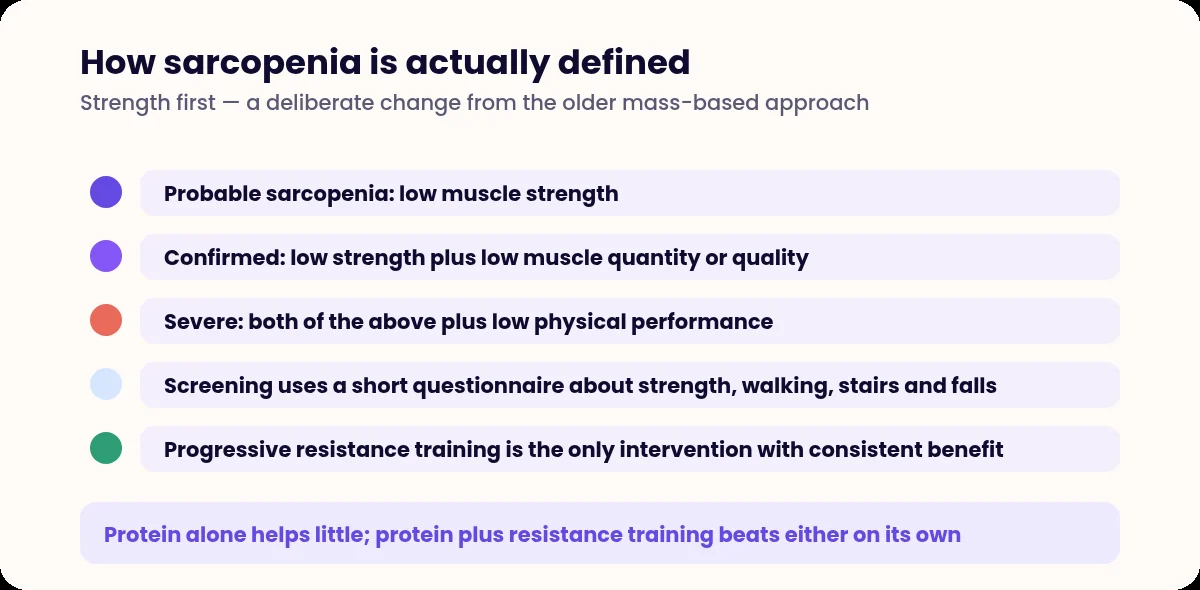
- Progressive resistance training is the only intervention with consistent benefit; protein alone has weak effects, but protein plus training beats either.
- The fat-free mass share of weight lost on GLP-1 medicines is broadly in line with diet-induced loss of similar size, but older adults with limited muscle reserve are the group to watch.
In 2019, the European working group on sarcopenia did something quietly important. It moved muscle strength to the front of the definition, ahead of muscle mass.
That was a deliberate reversal. The earlier framework led with quantity of muscle, on the reasonable assumption that mass drives function. The revision reflects a decade of evidence that strength predicts falls, disability and mortality better than mass does, and that the two can diverge considerably in older people.
The EWGSOP2 framework
Three stages [1]:
- Probable sarcopenia: low muscle strength
- Confirmed sarcopenia: low strength plus low muscle quantity or quality
- Severe sarcopenia: all three, including low physical performance
Strength alone is enough to trigger assessment and intervention. You do not need a body composition scan to act.
The cut-offs
Strength – Grip strength below 27 kg in men, below 16 kg in women – Five-times chair stand taking more than 15 seconds
Muscle quantity – Appendicular skeletal muscle mass below 20 kg in men, below 15 kg in women – Or ASM divided by height squared below 7.0 kg/m² in men, 6.0 in women
Physical performance – Gait speed of 0.8 m/s or less – Short Physical Performance Battery score of 8 or less – Timed Up and Go of 20 seconds or more
Screening usually begins with SARC-F, a five-item questionnaire covering strength, walking, rising from a chair, stair climbing and falls.
The chair stand test is the one worth knowing, because it needs no equipment. Five rises from a standard chair without using your arms, timed. Over 15 seconds is the threshold.
How common is it
Roughly 10 to 16% of older adults, considerably higher in hospitalised and care home populations. Prevalence estimates vary substantially depending on which definition and cut-offs are applied, which is a recurring problem in this literature.
Sarcopenic obesity — low muscle strength and mass coexisting with excess adiposity — has its own consensus definition, published by ESPEN and EASO in 2022 [2]. It is estimated to affect 10 to 20% of older adults, and it carries worse functional and mortality outcomes than either condition alone.
That combination is easy to miss. Excess body weight hides muscle loss from casual observation, and BMI says nothing useful about it. Someone can be both overweight and functionally weak, and the second problem is the one that determines whether they can get off the floor.
What actually helps
Progressive resistance training is the only intervention with consistent benefit. That finding is robust and it has not been displaced by anything.
Protein supplementation alone has weak and inconsistent effects. Protein plus resistance training outperforms either on its own. The protein is a permissive condition, not a treatment.
Recommended intakes for older adults sit at 1.0 to 1.2 g per kg per day when healthy, rising to 1.2 to 1.5 with illness [4]. Note how far above the UK Reference Nutrient Intake of 0.75 g/kg/day that sits — the UK figure has not been updated for this literature, as protein timing explains.
Vitamin D correction helps only where there is a deficiency. It is not a general muscle treatment.
There is no licensed pharmacotherapy for sarcopenia. Anything sold as one is not.
Practical guidance on getting started is in strength training over 40, and the NHS recommends muscle-strengthening activity on at least two days a week for older adults [3].
Weight loss medicines and muscle
This deserves a careful, unsensational treatment, because the coverage has been poor in both directions.
The observation: a substantial share of the weight lost with GLP-1 medicines is fat-free mass, commonly quoted at roughly 25 to 40% of total weight lost.
The context that is usually omitted: that proportion is broadly in line with diet-induced weight loss of similar magnitude. Losing weight by any means costs some lean tissue. The honest framing is “not clearly worse than equivalent diet-induced loss”, not “these medicines destroy muscle”.
Four caveats that are genuinely important:
- Fat-free mass is not the same as muscle. It includes water, glycogen and organ mass, all of which fall as body size falls. The headline percentage overstates contractile tissue loss.
- Older adults with limited muscle reserve are the concern group. The same proportional loss matters far more when you started closer to the grip strength cut-off.
- On stopping, fat regain can exceed lean regain. Over repeated cycles of loss and regain, that can shift body composition unfavourably and worsen sarcopenic obesity. See stopping weight loss medication.
- The recommended mitigation is resistance training plus adequate protein, and its effectiveness specifically alongside this therapy remains unproven. It is extrapolated from the wider literature. That is a reasonable basis for the advice and it is not the same as evidence.
The detailed picture is covered in muscle loss on weight loss medicines. None of this is an argument against treating obesity in later life. Obesity itself impairs function, and the risks of doing nothing are not zero.
Why strength-first was the right call
There is a practical reason the reordering matters beyond the academic one. Muscle quantity requires DXA, bioimpedance or imaging, none of which is routinely available in a ten-minute primary care appointment. Strength requires a chair and a stopwatch, or a hand dynamometer that costs very little.
Putting strength first therefore made the condition detectable in the settings where older people are actually seen. A definition that can only be applied in a research unit identifies nobody. That is a small point about measurement with a large effect on how many people get assessed at all.
A sensible approach after 60
- Do the chair stand test. Five rises, no arms, timed. Over 15 seconds warrants a conversation with your GP.
- Resistance train at least twice a week, progressively.
- Aim for 1.0 to 1.2 g/kg/day of protein minimum, spread across meals.
- If you are losing weight, do both of the above throughout, not afterwards.
- Track function, not just weight — how easily you climb stairs, carry shopping, get up from a chair.
When to speak to a clinician
- Five chair rises taking more than 15 seconds, or a noticeable drop in grip or walking speed
- Any fall, or near-fall — arrange a GP appointment, as falls assessment is available
- Unintentional weight loss at any age — this needs assessment, not reassurance
- Before starting resistance training with significant heart or lung disease, or recent surgery
Frequently asked questions
What is sarcopenia?
Age-related loss of muscle strength, mass and function. Under the EWGSOP2 definition, probable sarcopenia means low muscle strength; confirmed sarcopenia adds low muscle quantity or quality; severe sarcopenia includes low physical performance as well. Prevalence is roughly 10-16% of older adults, much higher in hospital and care home populations.
How is sarcopenia tested?
Screening usually starts with the SARC-F questionnaire, covering strength, walking, rising from a chair, climbing stairs and falls. Strength is then measured by grip dynamometry or a timed five-times chair stand. Muscle quantity and physical performance measures follow if strength is low.
Does losing weight cause muscle loss in older adults?
Some loss of fat-free mass accompanies most weight loss, by any method. The concern in later life is that older adults start with less reserve, so the same proportional loss has greater functional consequences. This is an argument for resistance training and adequate protein during weight loss, not against weight loss itself.
Do weight loss injections cause muscle loss?
A substantial share of the weight lost is fat-free mass, commonly quoted at roughly 25-40% of total weight lost. That is broadly in line with diet-induced weight loss of similar magnitude, so the fair framing is not clearly worse rather than uniquely harmful. Fat-free mass also includes water and glycogen, which complicates the figure.
References
- Cruz-Jentoft AJ, Bahat G, Bauer J, et al. Sarcopenia: revised European consensus on definition and diagnosis. Age and Ageing. 2019;48(1):16-31. doi.org/10.1093/ageing/afy169
- Donini LM, Busetto L, Bischoff SC, et al. Definition and diagnostic criteria for sarcopenic obesity: ESPEN and EASO consensus statement. 2022. doi.org/10.1159/000521241
- NHS. Physical activity guidelines for older adults. www.nhs.uk/live-well/exercise/physical-activity-guidelines-older-adult
- Bauer J, Biolo G, Cederholm T, et al. Evidence-based recommendations for optimal dietary protein intake in older people. JAMDA. 2013;14(8):542-559. doi.org/10.1016/j.jamda.2013.05.021
Medical reviewer
Naeem Teni
Clinical Lead at Manova. Registered pharmacist and independent prescriber, GPhC 2215591. Reviews Manova’s clinical content for accuracy and safety.
Written by
Manova Editorial Team
Researched and written to our editorial policy, using NICE, NHS, MHRA and peer-reviewed sources.
This article is for general information and isn’t a substitute for advice from your own clinician. If you feel unwell, contact your GP or NHS 111. In an emergency, call 999.