

Key takeaways
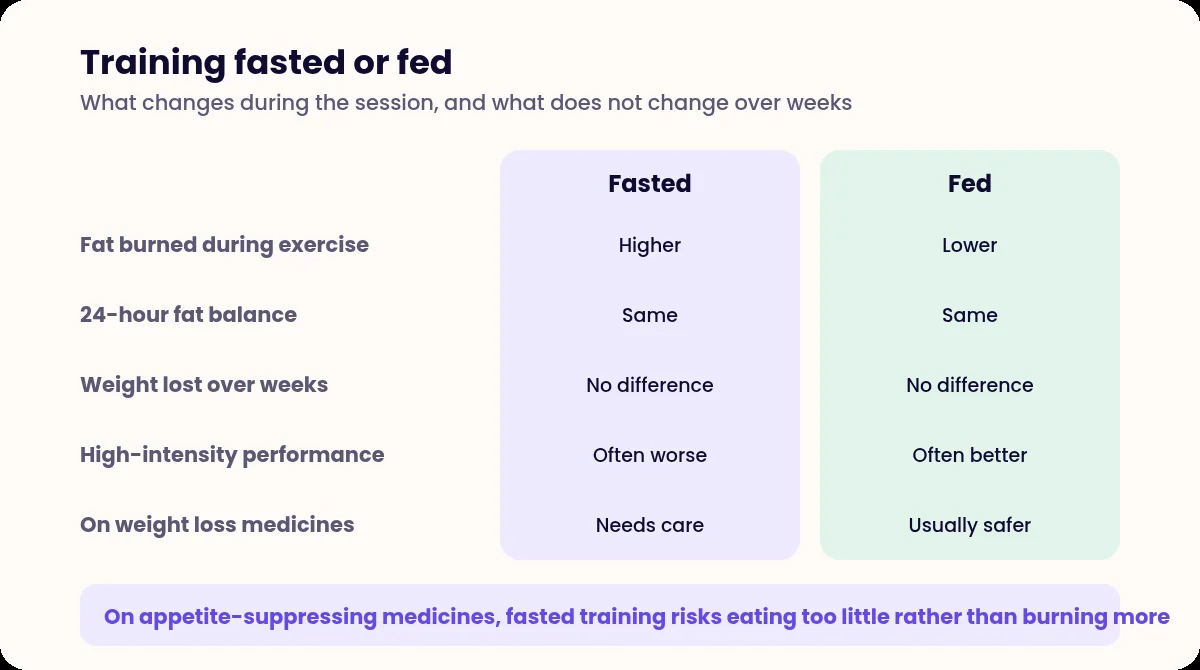
- Fasted exercise does increase fat oxidation during the session, but 24-hour fat oxidation and fat balance equalise once the fed period afterwards is counted.
- A meta-analysis of five studies in 96 young adults found no significant difference in body mass, body fat percentage or lean mass between fasted and fed exercise.
- Fasted training often reduces performance at higher intensities, which can lower total training volume and total energy expenditure.
- For people on a weight loss medicine, fasted training carries real safety considerations rather than just being a preference.
Fasted training is unusual among fitness claims in that the mechanism people cite is correct. Exercise before breakfast genuinely does draw a greater proportion of its fuel from fat.
The problem is what happens for the other 23 hours.
The bit that is true
With low insulin and depleted liver glycogen after an overnight fast, fat oxidation during exercise rises. This has been demonstrated repeatedly in laboratory conditions and is not in dispute [2].
If you put someone on a treadmill before breakfast and measure respiratory exchange ratio, you will see more fat being used. That measurement is real.
The bit that gets left out
Fuel use during a session is not the same as fat balance over a day.
Eat after a fasted session and the body preferentially oxidises the incoming carbohydrate, storing less fat than it otherwise would have. Eat before a session and you burn more carbohydrate during it, then oxidise more fat afterwards. Over 24 hours, fat oxidation and fat balance equalise.
The body is not keeping a fat-burning scoreboard for the hour you spent on the bike. It settles the books daily, and the input that determines whether fat stores shrink is the energy balance across the whole day, which is the same principle set out in what a calorie deficit really is.
What the outcome trials found
Hackett and Hagstrom, 2017, pooled five studies in 96 participants aged 21 to 27 comparing overnight-fasted with fed exercise [1]. Within-group effects on body mass were trivial to small (effect sizes 0.01 to −0.12). Between-group differences were trivial (0.02 to 0.05) and not statistically significant. Body fat percentage and lean mass showed no significant differences either.
The authors’ conclusion: fasted compared with fed exercise does not increase the amount of weight loss or fat mass loss.
Vieira and colleagues, 2016, reached the same place from the other direction [2]: fasted aerobic exercise increases fat oxidation during exercise, without producing a body composition advantage.
A 2025 randomised trial of fasted versus fed resistance training found no meaningful difference in training adaptations, which closes off the last common version of the claim.
Two caveats worth stating. The trial populations are small and skew young, so this is not a large evidence base. And the studies compare fasted with fed exercise at matched energy intake, which is the right question but not the only one people have.
The argument against fasted training that nobody makes
It is not that it burns less fat. It is that it can reduce how much work you do.
Fasted training frequently reduces performance at higher intensities and over longer durations. Less work done means lower session energy expenditure, and over weeks it can mean a lower total training volume. If you are running intervals, doing a long ride, or lifting heavy, eating something first usually results in a better session.
For a 30 to 45 minute easy walk or steady session, it makes very little difference. For the kinds of exercise that do most for weight loss, the deciding question is which state lets you train harder and more often — not which one shows a nicer respiratory exchange ratio.
The honest practical answer, then: choose whichever supports adherence. Some people are nauseated by eating before exercise. Some feel weak without it. Both are fine. Neither has a metabolic advantage worth chasing.
If you are combining fasted training with a time-restricted eating window, the same logic applies and is expanded in intermittent fasting: the eating pattern works if it reduces intake, not because of the timing itself.
If you are taking a weight loss medicine, this is a safety question
This section matters more than everything above it, and it is the part usually missing from articles on fasted cardio.
GLP-1 medicines suppress appetite and slow gastric emptying. That is the point of them. The consequence is that many people taking them are eating well below requirement already, sometimes substantially. Layering fasted training onto that is not a neutral choice.
Inadequate energy and protein intake. If total daily intake is already low, training fasted makes it harder to get enough protein and energy around the session, and accelerated lean mass loss is the plausible result. This is the central concern covered in muscle loss on weight loss medicines, and resistance training with adequate protein is the standard mitigation — which is difficult to do properly while fasted and under-eating.
Dizziness, fatigue and lightheadedness are common early effects of GLP-1 medicines, particularly during dose escalation. Fasted exercise compounds all three. Feeling faint in a gym or several miles into a run is a practical hazard, not a minor inconvenience.
Hypoglycaemia. Risk is low with a GLP-1 medicine alone. It becomes real when one is combined with a sulfonylurea (such as gliclazide) or insulin. UK summaries of product characteristics advise considering dose reduction of those agents when a GLP-1 medicine is started, precisely because of this. Training fasted in that combination is a genuine safety issue and should be discussed with your prescriber before you do it, not after. Know the symptoms of a hypo and carry fast-acting carbohydrate [4].
Dehydration. Where nausea, vomiting or diarrhoea are present, fluid losses are already higher and exercising fasted adds to the deficit. Dehydration also raises the risk of acute kidney injury in this context. The side effects of weight loss medicines article covers when those symptoms need review.
A reasonable approach for most people on treatment: eat something with protein beforehand, keep sessions moderate during dose escalation, take fluid with you, and prioritise resistance training over fasted cardio. There is no fat-loss benefit being given up, because there was none to give up.
The short version
- Fasted training burns more fat during the session and the same amount over the day.
- Meta-analyses show no body composition advantage.
- It may reduce how hard and how long you can train, which is the only real downside for most people.
- On a weight loss medicine, it carries specific risks and warrants a conversation with your prescriber.
NHS guidance remains the sensible frame regardless of timing: 150 minutes of moderate activity a week, plus strength work and less time sitting [3]. When you do it is far less important than whether you do it.
When to speak to a clinician
Speak to a clinician before training fasted if you:
- take insulin or a sulfonylurea, whether or not you also take a weight loss medicine
- have diabetes of any type and are changing your training or eating pattern
- are getting dizziness, palpitations or lightheadedness during or after exercise
- have ongoing vomiting or diarrhoea, reduced urine output or persistent thirst, which need same-week review
- develop severe, persistent abdominal pain that radiates to the back while taking a GLP-1 medicine, which needs urgent assessment [5]
Frequently asked questions
Does fasted cardio burn more fat?
It burns a higher proportion of fat during the session itself, which is well established. But 24-hour fat oxidation and fat balance equalise once the post-exercise fed period is accounted for, and meta-analyses find no advantage for body composition. The within-session number does not translate into more fat lost.
Should I eat before a morning workout?
Whichever you will do consistently. If eating first makes you feel sluggish or nauseous, train fasted. If you find you train harder with something in you, eat. For longer or higher-intensity sessions, eating beforehand usually supports more work done, which matters more than fuel mix.
Is fasted training bad for muscle?
A 2025 randomised trial of fasted versus fed resistance training found no meaningful difference in adaptations. The bigger risk is indirect: if training fasted pushes total daily protein or energy intake lower, lean mass is more likely to suffer, and that matters most for people already eating well below requirement.
Can I train fasted on a GLP-1 medicine?
Discuss it with your prescriber first. Appetite suppression means intake is often already below requirement, dizziness and fatigue are common early effects, and dehydration risk is higher if you have nausea, vomiting or diarrhoea. Hypoglycaemia risk becomes real if a GLP-1 medicine is combined with a sulfonylurea or insulin.
References
- Hackett D, Hagstrom AD. Effect of overnight fasted exercise on weight loss and body composition: a systematic review and meta-analysis. Journal of Functional Morphology and Kinesiology. 2017;2(4):43. doi.org/10.3390/jfmk2040043
- Vieira AF, Costa RR, Macedo RCO, et al. Effects of aerobic exercise performed in fasted v. fed state on fat and carbohydrate metabolism in adults: a systematic review and meta-analysis. British Journal of Nutrition. 2016;116(7):1153-1164. doi.org/10.1017/S0007114516003160
- NHS. Physical activity guidelines for adults aged 19 to 64. www.nhs.uk/live-well/exercise/physical-activity-guidelines-for-adults-
- NHS. Low blood sugar (hypoglycaemia). www.nhs.uk/conditions/low-blood-sugar-hypoglycaemia/
- MHRA. Drug Safety Update: GLP-1 receptor agonists and acute pancreatitis. 29 January 2026. www.gov.uk/drug-safety-update
Medical reviewer
Naeem Teni
Clinical Lead at Manova. Registered pharmacist and independent prescriber, GPhC 2215591. Reviews Manova’s clinical content for accuracy and safety.
Written by
Manova Editorial Team
Researched and written to our editorial policy, using NICE, NHS, MHRA and peer-reviewed sources.
This article is for general information and isn’t a substitute for advice from your own clinician. If you feel unwell, contact your GP or NHS 111. In an emergency, call 999.