
Key takeaways
- Men tend to store more visceral fat around the organs. For men, a waist of 94 cm (37 in) or more raises health risk, and 102 cm (40 in) or more raises it substantially.
- Carrying excess weight is linked to lower testosterone and erection problems, and both often improve with weight loss.
- Men are under-represented in weight-loss programmes, but programmes designed around how men prefer to engage work well.
- Strength training, higher protein, fewer liquid calories and clear, measurable goals are practical wins.
Most weight-loss advice is written with women in mind, and most commercial programmes are used mainly by women. Yet in England 67% of men are overweight or living with obesity, compared with 61% of women, and men are less likely to be trying to lose weight (38% of men vs 52% of women) [10]. Men are also more likely to carry weight in the riskiest place.
This guide covers what’s genuinely different about weight for men, and the approaches with the best evidence.
Why weight affects men differently
Men store more fat around the organs
Before later life, men tend to store proportionally more visceral fat, the deep fat around the liver and intestines that’s closely linked to type 2 diabetes and heart disease [7]. That’s why a “beer belly” that feels firm rather than soft deserves attention. It’s usually more than a cosmetic issue. Our guide to visceral fat explains why.
Waist size matters more than the scales
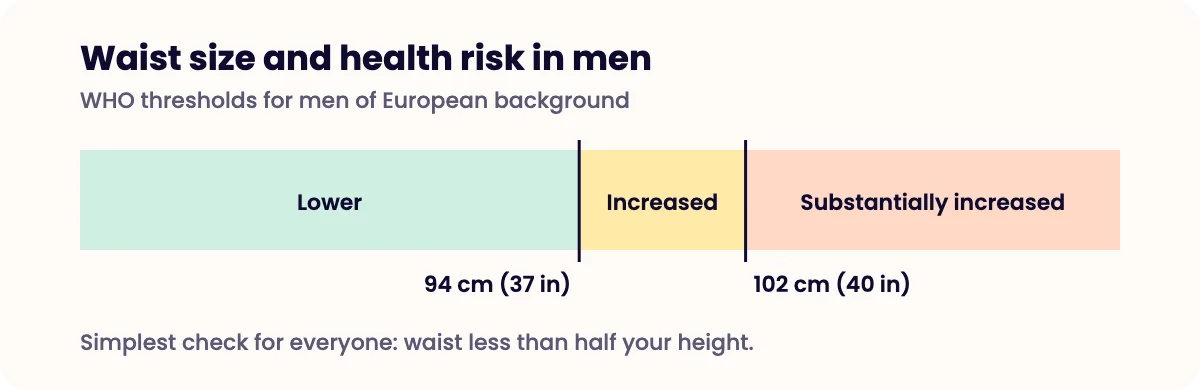
The World Health Organization uses these waist thresholds for men of European background [1]:
| Waist (men) | Health risk |
|---|---|
| Under 94 cm (37 in) | Lower |
| 94 cm (37 in) or more | Increased |
| 102 cm (40 in) or more | Substantially increased |
Lower cut-offs are often used for South Asian men. NICE recommends a simple rule that works for everyone: keep your waist to less than half your height [2]. See what is a healthy BMI in the UK for how to measure it.
Weight and testosterone
Excess body fat, especially around the middle, is linked to lower testosterone. Fat tissue converts some testosterone into oestrogen, and obesity can suppress the hormone signals that tell the testes to make testosterone. The encouraging part: a meta-analysis found that weight loss was associated with rises in testosterone, and the more weight men lost, the bigger the increase [3].
Weight and erections
Erection problems and excess weight share the same root causes: damage to blood vessels, insulin resistance and inflammation. In a randomised trial of men with obesity and erectile dysfunction, around a third of men in an intensive lifestyle programme regained normal erectile function within two years [4].
Erection problems can also be an early warning sign of heart disease, sometimes appearing years before other symptoms. They’re worth mentioning to a clinician, not just treating.
Men and weight-loss programmes
A major UK review commissioned by the NIHR found men are much less likely to join weight-loss programmes, but do well when programmes suit them. Men responded best to [5]:
- clear, factual information rather than “diet talk”
- practical goals and measurable progress
- a focus on physical activity alongside food
- settings where they feel comfortable, often with other men
The Football Fans in Training programme showed this well: men who took part at their football club lost around 5 kg more than a comparison group after 12 months [6].
What works for men: a practical plan
- Measure your waist, not just your weight. Check every two weeks. It’s the number most closely tied to health risk.
- Strength train twice a week. It protects muscle while you lose fat, supports testosterone and improves insulin sensitivity. Add at least 150 minutes of moderate activity such as brisk walking or cycling [9]. See how to lose weight without losing muscle.
- Build meals around protein. It keeps you full and supports muscle. Aim for a decent portion at every meal: eggs, Greek yoghurt, chicken, fish, lean mince, beans, lentils or tofu.
- Watch the liquid calories. Beer, lager and sugary drinks are among the biggest sources of “invisible” calories for many men. The UK low-risk guideline is no more than 14 units a week, spread over three or more days [8].
- Plan for the danger zones. Takeaways, work lunches, late-night snacking and weekends. Decide in advance what a good choice looks like.
- Sleep 7–9 hours. Short sleep increases appetite and lowers testosterone.
- Track one or two numbers. Steps, gym sessions or waist size. Men in the review valued seeing measurable progress [5].
- Get support if you need it. If you’ve tried on your own several times, a structured, clinician-led programme can help. There’s nothing weak about using the right tools.
When to speak to a clinician
See your GP or a registered clinician if you have:
- a waist of 102 cm (40 in) or more, or a waist-to-height ratio of 0.6 or more
- erection problems, low sex drive or persistent fatigue
- loud snoring, or pauses in breathing during sleep
- excessive thirst, passing urine often or blurred vision
Call 999 for chest pain, sudden breathlessness or stroke symptoms.
Frequently asked questions
What waist size is healthy for a man in the UK?
World Health Organization thresholds say men's health risk increases with a waist of 94 cm (37 inches) or more and is substantially higher at 102 cm (40 inches) or more. Lower cut-offs are often used for South Asian men. The simplest rule, recommended by NICE and the NHS for everyone, is to keep your waist to less than half your height.
Does losing weight increase testosterone?
In men with excess weight, it often does. A meta-analysis found that weight loss through diet or surgery was associated with increases in testosterone, with bigger rises in men who lost more weight. If you have symptoms of low testosterone, such as low libido, fatigue and erection problems, see a clinician for proper blood tests.
Can losing weight help erectile dysfunction?
It can. In a randomised trial of men with obesity and erectile dysfunction, around a third of those in a lifestyle programme regained normal erectile function after two years, compared with very few in the control group. Erection problems can also be an early sign of heart disease, so they're worth discussing with a clinician.
Do men lose weight faster than women?
On average men often lose weight a little faster at first, partly because they tend to be larger and have more muscle, which uses more energy. But individual differences are far bigger than differences between sexes, and long-term success depends on habits you can sustain.
References
- World Health Organization. Waist circumference and waist-hip ratio: report of a WHO expert consultation. Geneva, 8–11 December 2008. Published 2011. www.who.int/publications/i/item/9789241501491
- National Institute for Health and Care Excellence. Overweight and obesity management (NG246), section 1.9. Published 14 January 2025. www.nice.org.uk/guidance/ng246/chapter/Identifying-and-assessing-overw
- Corona G, Rastrelli G, Monami M, et al. Body weight loss reverts obesity-associated hypogonadotropic hypogonadism: a systematic review and meta-analysis. European Journal of Endocrinology. 2013;168(6):829-843. doi.org/10.1530/EJE-12-0955
- Esposito K, Giugliano F, Di Palo C, et al. Effect of lifestyle changes on erectile dysfunction in obese men: a randomized controlled trial. JAMA. 2004;291(24):2978-2984. doi.org/10.1001/jama.291.24.2978
- Robertson C, Archibald D, Avenell A, et al. Systematic reviews of and integrated report on the quantitative, qualitative and economic evidence base for the management of obesity in men. Health Technology Assessment. 2014;18(35). doi.org/10.3310/hta18350
- Hunt K, Wyke S, Gray CM, et al. A gender-sensitised weight loss and healthy living programme for overweight and obese men delivered by Scottish Premier League football clubs (FFIT): a pragmatic randomised controlled trial. The Lancet. 2014;383(9924):1211-1221. doi.org/10.1016/S0140-6736(13)62420-4
- Neeland IJ, Ross R, Després JP, et al. Visceral and ectopic fat, atherosclerosis, and cardiometabolic disease: a position statement. The Lancet Diabetes & Endocrinology. 2019;7(9):715-725. doi.org/10.1016/S2213-8587(19)30084-1
- Department of Health and Social Care. UK Chief Medical Officers' low risk drinking guidelines. www.gov.uk/government/publications/alcohol-consumption-advice-on-low-r
- Department of Health and Social Care. UK Chief Medical Officers' physical activity guidelines. Updated 10 July 2026. www.gov.uk/government/collections/physical-activity-guidelines
- NHS England. Health Survey for England, 2022 Part 2: Adult overweight and obesity. digital.nhs.uk/data-and-information/publications/statistical/health-su
Medical reviewer
Naeem Teni
Clinical Lead at Manova. Registered pharmacist and independent prescriber, GPhC 2215591. Reviews Manova’s clinical content for accuracy and safety.
Written by
Manova Editorial Team
Researched and written to our editorial policy, using NICE, NHS, MHRA and peer-reviewed sources.
This article is for general information and isn’t a substitute for advice from your own clinician. If you feel unwell, contact your GP or NHS 111. In an emergency, call 999.