

Key takeaways
- Erectile difficulty in men under 40 is considerably more common than most men assume, and is under-reported rather than rare.
- Psychological factors dominate in this age group, but a meaningful proportion of younger men have a physical contributor.
- Anabolic steroid use, recreational drugs, poor sleep and untreated mental health problems are common and treatable causes.
- ED at a young age is still a reason to have blood pressure, glucose and cholesterol checked, not less of one.
Erectile dysfunction is filed in most men’s heads as an older man’s problem. The data do not support that. Reviews of erectile dysfunction in men under 40 report prevalence figures that run considerably higher than most men would guess, and consistently conclude that it is under-recognised rather than uncommon in this age group.
That matters, because a young man who thinks he is the only one is far less likely to say anything — and this is a condition where the silence is often doing more harm than the original problem.
What’s usually going on
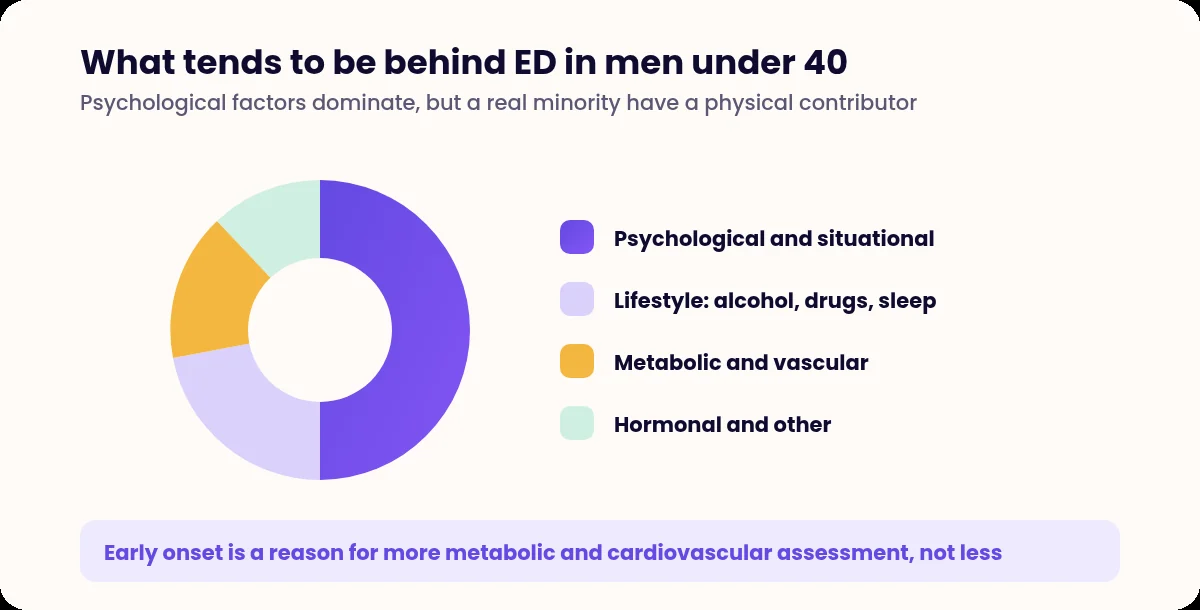
In younger men, psychological and situational factors are the most common drivers. That does not mean imaginary, and it does not mean easily willed away — anxiety produces a physiological state that actively opposes erection, which our guide to performance anxiety and erections explains in detail.
Common contributors in this age group:
Performance anxiety. Often triggered by one ordinary bad occasion — too much to drink, exhaustion, a new partner — which then becomes self-sustaining.
Alcohol and recreational drugs. Alcohol is the single commonest cause of a one-off failure. Cocaine, MDMA, cannabis and opioids all affect erectile function.
Anabolic steroids. Common and under-declared. Steroids suppress the body’s own testosterone production, and recovery after stopping can take many months. Worth raising honestly — it changes the interpretation of any blood test.
Sleep. Short and fragmented sleep lowers testosterone and raises sympathetic nervous system activity. Shift work is a particular culprit.
Mental health and its treatment. Depression and anxiety both affect sexual function, and so do several of the medicines used to treat them. That is a conversation to have openly rather than a reason to stop taking something — our guide to antidepressants and sexual side effects covers the options.
Relationship factors. Unspoken conflict, mismatched expectations, or simply not wanting to be there.
The physical side, which is not zero
A meaningful minority of younger men with erectile difficulty have an organic contributor, and the list is worth knowing:
- Metabolic factors — insulin resistance, undiagnosed type 2 diabetes, obesity, high blood pressure and high cholesterol. All of these damage the endothelium, and all are appearing earlier than they used to.
- Hormonal — testosterone deficiency, thyroid disease, raised prolactin. Uncommon but checkable, and our guide to low testosterone symptoms explains how it is properly tested.
- Anatomical — Peyronie’s disease, which can present in younger men, or congenital abnormalities.
- Neurological — much less common, but relevant after trauma or where there are other neurological symptoms.
- Medication — including some antidepressants, antipsychotics, and finasteride taken for hair loss.
Why age makes assessment more important, not less
There is a common assumption that a young man with erectile difficulty obviously does not need his heart checked. The logic runs the wrong way. Erectile dysfunction is an early marker of arterial dysfunction, and the penile arteries are narrow enough to show trouble years before larger vessels do. Consensus guidance now treats erectile dysfunction as a cardiovascular risk-enhancing factor, and an early onset argues for more metabolic and cardiovascular assessment, not less.
A reasonable work-up for a younger man includes blood pressure, HbA1c or fasting glucose, lipids, and a morning fasting testosterone, alongside a proper history covering medicines, recreational drugs, sleep, mood and relationship context [1, 3].
Clues that point one way or the other
Features that suggest a psychological contribution predominates: sudden onset, a clear trigger you can date it to, preserved morning erections, and situational variation — fine alone or with one partner, difficult with another.
Features that suggest an organic contribution: gradual onset over months, absent morning erections, and metabolic or cardiovascular risk factors.
Our guide to morning erections explains why that particular signal is useful but not diagnostic — plenty of men simply do not wake at the right moment to notice.
What helps
Address what is actually driving it. If that is alcohol, sleep, steroids or an untreated mood problem, treating those does more than any tablet.
Take the performance demand out. The most effective structural change is usually removing intercourse as the goal for a defined period, which is the basis of sensate focus work in psychosexual therapy.
Talk to your partner. Silence is read as rejection far more often than as anxiety.
Consider medication as a tool, not the treatment. Clinicians sometimes use a PDE5 inhibitor deliberately for a limited period to break the anxiety cycle, alongside psychological work, with a plan to reduce it. Used that way it is useful; used indefinitely as the only intervention it tends to become the thing the anxiety attaches to.
Get the lifestyle basics right — our guide to lifestyle changes for erections covers the evidence, most of which applies just as much at 25 as at 55.
When to see someone
If it has lasted more than a few weeks, if it is causing distress, if morning erections have gone, if there is any curvature or pain, or if you are using or have used anabolic steroids. None of those is a reason to wait and hope.
Frequently asked questions
Is it normal to have erection problems in your twenties?
It is common. Occasional difficulty happens to almost everyone and is usually explained by alcohol, tiredness, stress or a new situation. What warrants assessment is a pattern that persists over weeks or months, or one that is causing distress.
Does watching a lot of pornography cause erectile dysfunction?
The association is repeatedly reported but causality is not established and study quality is mixed. What is less contested is that a large gap between the arousal conditions you have trained on and partnered sex can make the latter feel flat. Reducing that gap is reasonable to try.
Could steroids have caused this?
Yes. Anabolic steroids suppress the body's own testosterone production, sometimes for a long time after stopping, and erectile difficulty and low libido are common consequences. It is important to mention honestly, because it changes both the tests and the treatment.
Should I just buy a tablet online?
A tablet may well work, but it treats the symptom. In a younger man the more useful question is why this is happening, and the answer is often something treatable that a tablet does not touch — sleep, mood, alcohol, medication or steroid use.
References
- NICE Clinical Knowledge Summaries. Erectile dysfunction. cks.nice.org.uk/topics/erectile-dysfunction/
- NHS. Erection problems (erectile dysfunction). www.nhs.uk/conditions/erection-problems-erectile-dysfunction/
- British Society for Sexual Medicine. Guidelines on the management of erectile dysfunction in men. www.bssm.org.uk/guidelines/
- European Association of Urology. Guidelines on Sexual and Reproductive Health. uroweb.org/guidelines/sexual-and-reproductive-health
- NHS. Mental health services. www.nhs.uk/mental-health/
Medical reviewer
Naeem Teni
Clinical Lead at Manova. Registered pharmacist and independent prescriber, GPhC 2215591. Reviews Manova’s clinical content for accuracy and safety.
Written by
Manova Editorial Team
Researched and written to our editorial policy, using NICE, NHS, MHRA and peer-reviewed sources.
This article is for general information and isn’t a substitute for advice from your own clinician. If you feel unwell, contact your GP or NHS 111. In an emergency, call 999.