
Key takeaways
- Acutely, alcohol depresses the central nervous system, dulls genital sensation, impairs the erectile reflex and delays or prevents ejaculation, while disinhibition raises sexual intent.
- In alcohol dependence, roughly 50 to 75% of men have at least one sexual dysfunction, with severity tracking the severity of dependence.
- A large meta-analysis found light-to-moderate drinking apparently protective for erectile function, but the finding is observational and vulnerable to sick-quitter bias and residual confounding — it is not a reason to drink.
- UK guidance is no more than 14 units a week, spread over three or more days, with several drink-free days.
Alcohol has two distinct relationships with sexual function, and they get confused constantly. There is what it does on the night, which is familiar, reversible and mostly about the nervous system. And there is what sustained heavy drinking does over years, which is quieter, structural and much less reversible.
Both are worth understanding, and so is a third thing: a large body of observational data that appears to show light drinking is good for erections, and why that should be treated with real suspicion.
On the night
Alcohol is a central nervous system depressant. Applied to sexual function, that produces a fairly consistent set of effects:
- Reduced arousal. The processing that turns stimulation into arousal is slowed.
- Dulled genital sensation. Peripheral sensory input is blunted.
- Impaired erectile reflex. The spinal reflex that produces and maintains an erection is interfered with directly.
- Delayed or absent ejaculation. This one catches people out, because it is often mistaken for stamina rather than recognised as impairment. Our guide to delayed ejaculation covers when it becomes a problem in its own right.
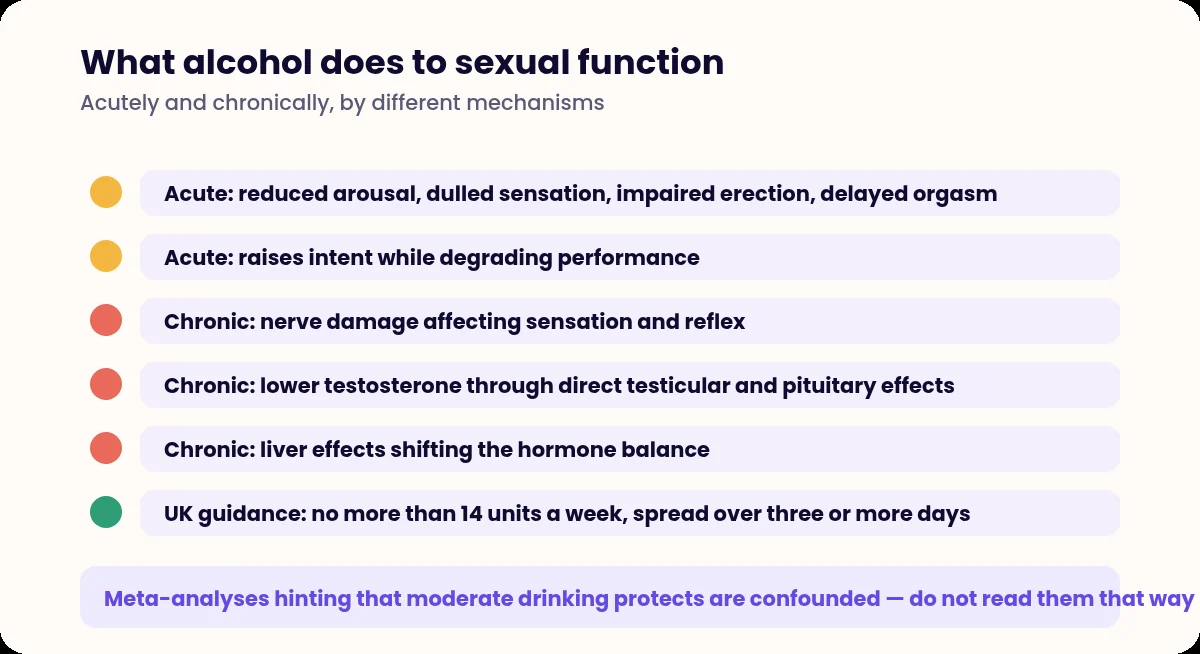
Layered on top is disinhibition, which increases sexual intent while performance is degrading. That mismatch is the whole mechanism behind the folk term, and it is also why an isolated bad night so often becomes something bigger. A man who could not manage it after six pints does not usually file that under “six pints”. He files it under “something is wrong with me”, and the anxiety that generates can outlast the hangover by months. That loop is covered in our guide to performance anxiety and erections.
If alcohol explains a one-off, the useful response is to name it as such and move on.
What sustained heavy drinking does
This is a different picture, and a considerably less forgiving one. In alcohol dependence, roughly 50 to 75% of men have at least one sexual dysfunction, with severity correlating with the severity of dependence.
The mechanisms stack:
Nerve damage. Peripheral and autonomic neuropathy affect both the sensory input and the autonomic signalling that erection and ejaculation depend on.
Hypogonadism. Alcohol is directly toxic to the Leydig cells in the testes that produce testosterone, and it also suppresses the hypothalamic-pituitary signalling above them. Testosterone falls from both ends.
Liver dysfunction. A damaged liver raises sex hormone binding globulin and shifts the ratio of oestrogen to androgen. Clinically this shows up as gynaecomastia and testicular atrophy in advanced disease.
Vascular damage. Adding to whatever else is affecting the endothelium.
Depression. Extremely common alongside heavy drinking, and independently a cause of low desire and erectile difficulty — as well as being treated with medicines that can themselves affect sexual function. Our guides to low libido in men and antidepressants and sexual side effects untangle that.
Because the mechanisms overlap, a man in this situation rarely has one clean problem. Desire, erection and ejaculation are typically all affected to some degree.
The finding that needs scepticism
Here is where most articles either ignore the evidence or oversell it.
The largest meta-analysis in this area — 46 studies and 216,461 participants, published in Urologia Internationalis in 2021 — found a J-shaped relationship between alcohol intake and erectile dysfunction, with light-to-moderate intake giving a pooled odds ratio of 0.82 (0.72–0.94): in other words, apparently protective [3].
That is a real result from a large dataset, and it should not be hidden. It should also not be believed uncritically, for three reasons.
Sick-quitter bias. The comparison group of non-drinkers is not made up of lifelong abstainers. It contains people who stopped drinking because they became unwell — because of liver disease, diabetes, cardiovascular disease, cancer or a medicine that made drinking inadvisable. Comparing moderate drinkers against that group flatters moderate drinking.
Residual confounding. In many populations, moderate drinking travels with higher income, better housing, more social connection, more exercise and better access to healthcare. Statistical adjustment reduces this but does not remove it. The same J-shaped curve appeared for years in the cardiovascular literature and has been substantially undermined by better-designed analyses.
It conflicts with UK policy. The UK Chief Medical Officers’ position is that there is no completely safe level of alcohol consumption [2]. A finding that a little is better than none sits awkwardly against a much broader evidence base on cancer, liver disease and injury.
The practical conclusion: this is not a reason to drink, and nobody should start or increase drinking because of it. What it reasonably supports is a more modest claim, which is that light drinking is not the main threat to erectile function. Heavy drinking is.
The UK numbers
UK guidance is no more than 14 units a week for both men and women, spread over three or more days rather than concentrated, with several drink-free days each week [1, 2].
One unit is 10ml or 8g of pure alcohol. Fourteen units is roughly six pints of average-strength beer, or ten small glasses of lower-strength wine. Worth noting how easily a single evening consumes a week’s allowance — a large glass of 13% wine is a little over three units, so three of them is most of the way there.
Binge patterns matter separately from weekly totals. Concentrating fourteen units into one night is not equivalent to spreading them, for sexual function or anything else.
If you want to test whether alcohol is the problem
Give it a proper trial rather than a token one.
- Pick a meaningful reduction and hold it for two to three months. The acute effects disappear immediately, but hormonal, mood and nerve-related changes take months.
- Watch desire separately from erections. They recover on different timelines and it is useful to know which improved.
- Look at sleep too. Alcohol fragments sleep and suppresses the REM sleep during which night-time erections occur. Poor sleep is independently associated with erectile difficulty, and this is one of the routes by which alcohol acts. See our guide to morning erections.
- Be honest with your clinician about the amount. Under-reporting is close to universal and it changes which tests are sensible — a morning fasting testosterone, liver function and HbA1c, for example.
If you are drinking daily and dependent, do not stop abruptly without medical advice. Alcohol withdrawal can be dangerous, and there are NHS services that can manage a supervised reduction. Speak to your GP, and if you develop confusion, tremor or seizures during withdrawal, that needs urgent medical attention.
Frequently asked questions
Why can't I get an erection when I've been drinking?
Alcohol is a central nervous system depressant. It reduces arousal processing in the brain, dulls genital sensation and interferes with the reflex that produces an erection, while disinhibition often increases sexual intent at the same time. The result is wanting to more and being able to less. It is extremely common and, after an isolated heavy night, not a sign of anything wrong.
Does alcohol lower testosterone?
Heavy and sustained drinking does. It is directly toxic to the Leydig cells in the testes that make testosterone, and it suppresses the hypothalamic-pituitary signalling above them. Liver dysfunction adds to the effect by raising sex hormone binding globulin and shifting the oestrogen to androgen ratio, which is why gynaecomastia and testicular atrophy appear in advanced liver disease.
Is a couple of drinks actually good for erections?
No — and the study that appears to say so should be read carefully. The pooled finding of apparent benefit at light-to-moderate intake comes from observational data, where the non-drinking comparison group includes people who stopped because they were already unwell. UK health policy is clear that there is no completely safe level of drinking.
How long after cutting down would I notice a difference?
For the acute effects, immediately — the next occasion you are sober. For effects related to sustained heavy drinking, changes in hormones, nerve function and mood take months, and some nerve damage may not fully reverse. A sensible trial is a genuine reduction held for two to three months before judging.
References
- NHS. Alcohol units and the low risk drinking guidelines. www.nhs.uk/live-well/alcohol-advice/calculating-alcohol-units/
- UK Chief Medical Officers. Low risk drinking guidelines. www.gov.uk/government/publications/alcohol-consumption-advice-on-low-r
- Meta-analysis of alcohol consumption and erectile dysfunction, 46 studies, 216,461 participants. Urologia Internationalis, 2021. pubmed.ncbi.nlm.nih.gov/
- NICE Clinical Knowledge Summaries. Erectile dysfunction. cks.nice.org.uk/topics/erectile-dysfunction/
- British Society for Sexual Medicine. Guidelines on the management of erectile dysfunction in men. www.bssm.org.uk/guidelines/
- NHS. Tips on cutting down on alcohol. www.nhs.uk/live-well/alcohol-advice/tips-on-cutting-down-alcohol/
Medical reviewer
Naeem Teni
Clinical Lead at Manova. Registered pharmacist and independent prescriber, GPhC 2215591. Reviews Manova’s clinical content for accuracy and safety.
Written by
Manova Editorial Team
Researched and written to our editorial policy, using NICE, NHS, MHRA and peer-reviewed sources.
This article is for general information and isn’t a substitute for advice from your own clinician. If you feel unwell, contact your GP or NHS 111. In an emergency, call 999.