

Key takeaways
- A 2025 systematic review of 43 randomised trials and 1,877 participants concluded there is moderate evidence that PRP is safe and effective in improving hair density.
- The same review named its central limitation: heterogeneity in study design and incomplete reporting of PRP composition prevented any meaningful analysis of which PRP preparation works.
- There is no standard PRP — spin protocol, platelet concentration, leucocyte content, activation, injection depth and session schedule all vary, so two clinics' PRP are not the same intervention.
- PRP is not a licensed medicine in the UK, has no MHRA marketing authorisation or NICE appraisal, and is not available on the NHS for hair loss.
Platelet-rich plasma is your own blood, drawn, spun in a centrifuge to concentrate the platelet fraction, and injected into the scalp. The proposed mechanism is that platelet growth factors — PDGF, VEGF, IGF-1 among them — prolong the growing anagen phase of the hair cycle.
It is one of the few hair treatments where the fair summary genuinely sits between the two camps. The evidence is better than the sceptics allow. It is also far less useful to an individual than the clinics quoting it imply, and for a reason that is easy to state and hard to get around.
What the best evidence says
The strongest single source is a systematic review and meta-analysis published in Dermatology and Therapy in 2025, online on 13 September 2025 [1]. It included 43 randomised controlled trials, with 41 in the quantitative synthesis and 1,877 participants, around 73% of them male, and used the RoB 2 tool to assess risk of bias.
Its conclusion, stated in its own words: “moderate evidence… PRP is safe and effective in improving hair density” [1].
Two sub-findings are worth carrying forward. Activated PRP outperformed placebo, and non-activated PRP was associated with more adverse effects [1]. A 2024 review in the Journal of Cosmetic Dermatology reached a similar conclusion with similar caveats [2].
That is a genuinely positive body of evidence by the standards of cosmetic dermatology, and it deserves to be reported as such rather than dismissed.
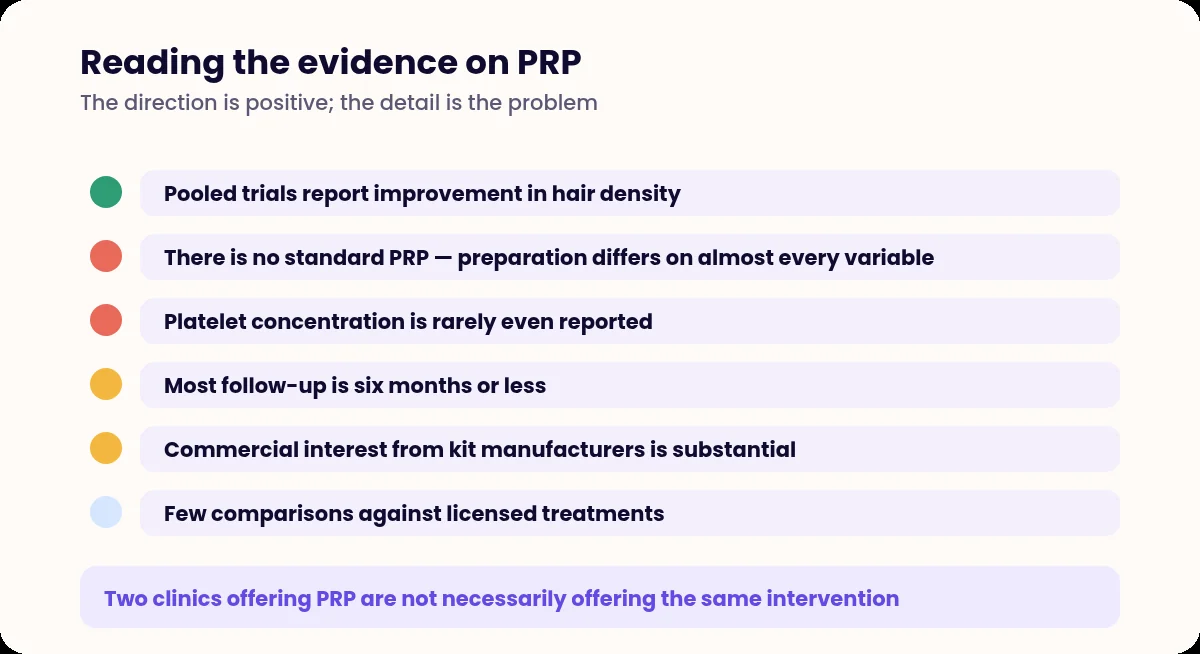
The limitation the authors named themselves
Here is the sentence that should shape how you use the finding above. The review’s own stated limitation was that heterogeneity in study designs and incomplete reporting of PRP composition prevented meaningful subtype analysis [1].
In other words: the trials worked, on average, but the review could not determine which PRP worked, because the trials mostly did not report what they had made.
There is no standard PRP
Quantify the variation and the problem becomes obvious. Trials differ on [1]:
- spin protocol and g-force, and whether one spin or two
- final platelet concentration, which is rarely reported at all
- leucocyte-rich versus leucocyte-poor preparations
- activation with calcium chloride or thrombin, versus no activation
- injection depth and volume
- number of sessions — commonly three or four
- interval between sessions — anywhere from two to six weeks
- maintenance frequency thereafter
Every one of those is a variable that could plausibly change the biology. A leucocyte-rich, unactivated, single-spin preparation injected at one depth every six weeks is not the same intervention as a leucocyte-poor, calcium-activated, double-spin preparation injected at another depth every two weeks. They share a name and an acronym.
The practical consequence: two clinics’ “PRP” are not the same intervention, so a pooled estimate from 41 trials is of limited use in predicting what one particular clinic will achieve for one particular person. That is not a reason to dismiss PRP. It is a reason to be sceptical of any clinic that quotes a pooled effect size as though it applied to their protocol.
The other weaknesses, stated plainly
Beyond heterogeneity, the literature has the problems you would expect of a commercially driven field [1, 2]:
- small samples in most individual trials
- short follow-up, mostly six months or less, so durability is essentially unstudied
- many half-head designs, where one side of the scalp is treated and the other is control — elegant, but vulnerable to systemic effects and to unblinding
- inconsistent outcome measures between trials
- substantial commercial interest from kit manufacturers, with many studies manufacturer-supported or built around a single proprietary system
- publication bias is likely, as it is in any field where positive results sell equipment
Where UK regulation sits
PRP for hair loss is not a licensed medicine in the UK. There is no MHRA marketing authorisation, no NICE technology appraisal, and no Clinical Knowledge Summaries recommendation for it in androgenetic alopecia [3, 4].
The reason is structural rather than a judgement on the evidence. PRP is delivered as an autologous, minimally manipulated blood product prepared at the point of care — your own blood, spun and returned to you — which sits outside the medicines licensing framework. What is regulated are the kits and centrifuges, as UKCA or CE-marked medical devices [3]. A clinic can honestly say its equipment is regulated. That is a statement about a centrifuge, not about a treatment.
It is not available on the NHS for hair loss [4].
What it costs
UK clinics typically advertise £400 to £900 per session, with three or four initial sessions and maintenance every four to six months. That commonly works out at an advertised £1,500 to £3,000 in the first year, followed by an open-ended ongoing commitment.
Treat those as advertised prices rather than surveyed figures — nobody has systematically surveyed what UK patients actually pay, and the range is wide. The more important number is the one nobody advertises: this is a recurring cost with no endpoint, because stopping returns the scalp to its untreated trajectory. Our guide to what private treatment costs in the UK covers how to compare that against alternatives.
An honest position
Pulling it together:
- The direction of effect is consistently positive across a reasonable number of randomised trials.
- The safety profile is good — it is autologous, and the adverse events reported are mild and transient pain, swelling and tenderness at the injection sites.
- The effect sizes are modest.
- The intervention is unstandardised, so the evidence does not transfer cleanly to any specific clinic.
- Comparisons against licensed treatments are few, so we do not know how it stacks up against the options that do have a UK licence.
- Durability beyond six to twelve months is essentially unstudied.
Promising but not established is the accurate description. PRP is reasonable as an adjunct for someone already on a licensed treatment who wants to do more, and it is not a substitute for a licensed treatment — topical minoxidil is a pharmacy medicine with a UK licence for pattern hair loss, and choosing an unlicensed injection instead of it is a decision worth examining. Our guide to minoxidil explained covers that baseline.
If you are weighing PRP against other adjuncts, microneedling for hair loss and laser caps for hair loss sit in the same category of modest evidence and private cost, and hair transplants in the UK covers the one intervention that moves follicles rather than trying to revive them.
Frequently asked questions
Does PRP actually work for hair loss?
The direction of effect across randomised trials is consistently positive, and a 2025 meta-analysis of 43 trials concluded there is moderate evidence of improved hair density. The effect sizes are modest, follow-up is mostly six months or less, and the preparations tested vary enormously. Promising but not established is the fair summary, and it should sit alongside a licensed treatment rather than instead of one.
How much does PRP cost in the UK?
UK clinics typically advertise £400 to £900 per session. A common initial course is three to four sessions with maintenance every four to six months, which is usually advertised at somewhere between £1,500 and £3,000 in the first year and then continues indefinitely. These are advertised prices rather than surveyed figures, and they vary widely.
Is PRP available on the NHS?
No. PRP for hair loss has no MHRA marketing authorisation, no NICE technology appraisal and no place in NHS commissioning for androgenetic alopecia. It is a private treatment only.
Is PRP regulated in the UK?
Not as a medicine. PRP is prepared at the point of care from your own blood and is treated as an autologous, minimally manipulated blood product. What is regulated are the kits and centrifuges, which carry UKCA or CE marks as medical devices. Regulation of the equipment is not the same as regulatory assessment of the treatment.
References
- Platelet-Rich Plasma in the Management of Alopecia: A Systematic Review and Meta-Analysis. Dermatology and Therapy, 2025;15(11):3213-3252, online 13 September 2025. link.springer.com/guides/13555
- Donnelly J et al. Platelet-rich plasma for androgenetic alopecia. Journal of Cosmetic Dermatology, 2024. onlinelibrary.wiley.com/guides/14732165
- MHRA. Regulating medical devices in the UK. www.gov.uk/guidance/regulating-medical-devices-in-the-uk
- NICE Clinical Knowledge Summaries. Alopecia, androgenetic. cks.nice.org.uk/topics/alopecia-androgenetic/
- DermNet. Platelet-rich plasma. dermnetnz.org/topics/platelet-rich-plasma
- NHS. Hair loss. www.nhs.uk/conditions/hair-loss/
Medical reviewer
Naeem Teni
Clinical Lead at Manova. Registered pharmacist and independent prescriber, GPhC 2215591. Reviews Manova’s clinical content for accuracy and safety.
Written by
Manova Editorial Team
Researched and written to our editorial policy, using NICE, NHS, MHRA and peer-reviewed sources.
This article is for general information and isn’t a substitute for advice from your own clinician. If you feel unwell, contact your GP or NHS 111. In an emergency, call 999.