

Key takeaways
- Short-term randomised trials find non-sugar sweeteners modestly reduce body weight and BMI when they replace sugar.
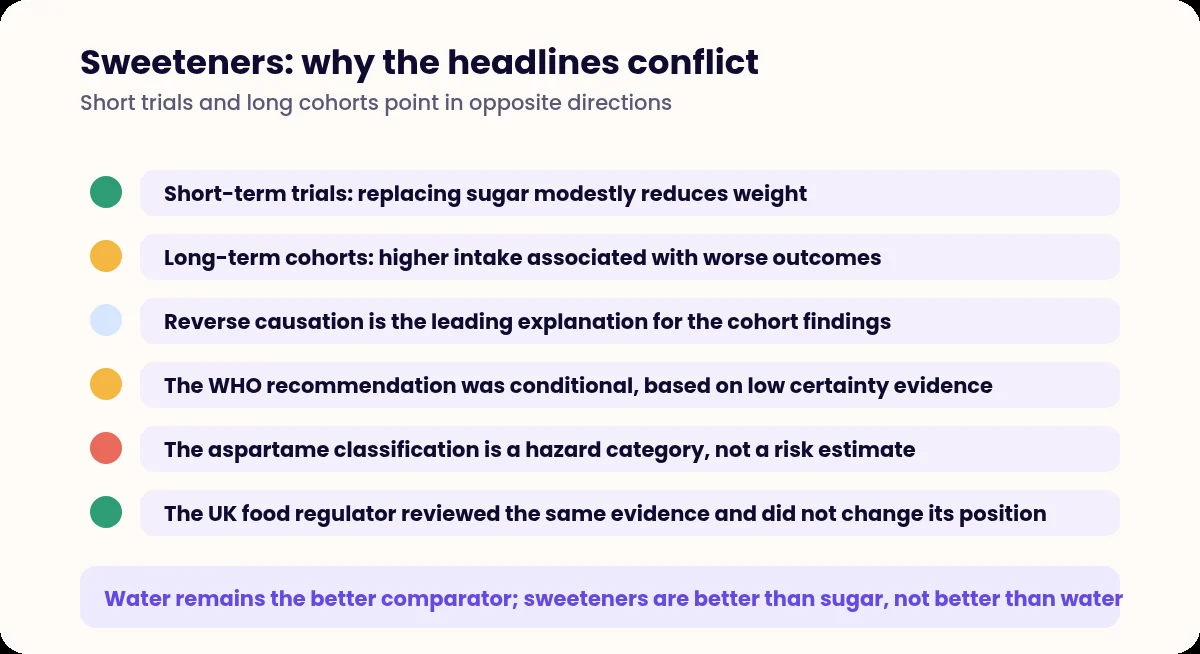
- Long-term cohort studies find higher sweetener intake associated with worse metabolic outcomes, with reverse causation the leading explanation.
- The WHO's 2023 recommendation was conditional and based on low certainty evidence; both qualifiers were widely dropped from press coverage.
- The IARC classified aspartame as possibly carcinogenic, which is a hazard classification, while JECFA simultaneously reaffirmed the acceptable daily intake.
There are two bodies of evidence on sweeteners and they point in opposite directions. Most coverage picks one, reports it as the answer, and moves on.
Understanding why they disagree is genuinely more useful than knowing either result, because the disagreement is the finding.
The two literatures
Short-term randomised controlled trials. When people are randomised to replace sugar-sweetened products with sweetened alternatives, they modestly reduce body weight and BMI. This is not surprising. A can of sugar-sweetened drink carries around 140 kcal and the sweetened version carries almost none, and people do not reliably compensate for the difference elsewhere.
Long-term prospective cohorts. People who report consuming more non-sugar sweeteners have higher subsequent risk of type 2 diabetes, cardiovascular disease and mortality. This finding is consistent across many cohorts, which is why it gets attention.
Both can be true, and the most likely reason they are is reverse causation.
Reverse causation, and why it is not a dismissal
People do not take up diet drinks at random. They switch because they have gained weight, because a clinician has raised their blood glucose, because a family member has developed diabetes, or because they are already trying to manage a metabolic problem. The exposure follows the risk rather than causing it.
Cohort studies adjust for measured confounders, but they cannot adjust for the reason someone changed their drink, and residual confounding by baseline adiposity is difficult to remove entirely. The WHO explicitly acknowledges reverse causation as a plausible explanation for the cohort findings in its own guideline [1].
That does not make the cohort signal worthless. It means the cohorts cannot settle the question, and that the randomised evidence — which is short, but is randomised — carries more weight for the specific question of what happens when you swap sugar for a sweetener.
What the WHO guidance said, and what it did not
On 15 May 2023 the WHO issued a guideline stating that it “suggests that non-sugar sweeteners not be used as a means of achieving weight control or reducing the risk of noncommunicable diseases” [1].
Two qualifiers were attached in the document itself and stripped almost everywhere else:
- The recommendation was graded conditional, the weaker of the two WHO categories, meaning the guideline development group judged that most but not all informed people would choose it and that policy needs local debate.
- The underlying evidence was rated low certainty.
Also frequently lost:
- It covers acesulfame K, aspartame, advantame, cyclamates, neotame, saccharin, sucralose and stevia.
- It applies to everyone including children and pregnant women except people with pre-existing diabetes.
- It does not cover sugar alcohols or polyols, and does not cover sweeteners in medicines and personal care products.
The substantive point the guidance makes is narrower than the headlines: sweeteners are not a long-term strategy for weight control, and reducing overall sweetness of the diet is preferable. That is a defensible position. “Sweeteners cause weight gain” is not what it says.
Aspartame: two assessments, routinely conflated
On 14 July 2023 two separate WHO-affiliated bodies published on the same day, which produced predictable confusion [2].
IARC classified aspartame as Group 2B, “possibly carcinogenic to humans”, on limited evidence. IARC classifies hazard, not risk — whether something could cause cancer under some circumstances, not how likely it is at real exposures. Group 2B also contains aloe vera extract and pickled vegetables. It is the weakest category that is not “not classifiable”.
JECFA, which does assess risk, reaffirmed the acceptable daily intake of 0 to 40 mg per kg of body weight and concluded the evidence of an association with cancer in humans is not convincing. A 70 kg adult would need to drink more than 9 to 14 cans of diet soft drink a day to exceed the ADI.
The UK position diverged from the WHO framing and did not shift. The Food Standards Agency and the UK Committee on Toxicity consider approved sweeteners safe at permitted levels; the FSA reviewed both 2023 outputs and made no change to its position or to the ADI [3]. NHS advice is unchanged [6]. This is one of those places where UK and international messaging genuinely differ, and it is worth knowing which one your search results are quoting.
The emerging areas, flagged as emerging
Gut microbiome. A 2022 study reported that some non-nutritive sweeteners altered the gut microbiome and glucose tolerance in a person-specific way [4]. Small sample, short duration, and the clinical significance is unknown. Interesting, not actionable. If you want the broader picture there, gut health and weight covers how thin that evidence base still is.
Erythritol. A 2023 study reported an association between circulating erythritol and cardiovascular thrombotic events [5]. Erythritol is a polyol, outside the scope of the WHO guideline entirely, and it is also produced endogenously, which complicates interpretation of blood levels. Preliminary.
Neither finding has changed UK regulatory advice, and neither should change what you do this week.
A workable position
For someone trying to lose weight, the practical hierarchy is not controversial:
- Water, or unsweetened tea and coffee, is the best replacement for a sugar-sweetened drink. It is also the swap with the largest reliable effect on energy intake, as set out in hydration and weight loss.
- A sweetened drink instead of a sugar-sweetened one is a clear improvement on the sugar version, and if it is what makes the change stick, it is a reasonable choice.
- Neither is a health food. Diet drinks are not a reason to relax elsewhere, and several appear in the ultra-processed category discussed in ultra-processed food and weight.
A practical caution: sweeteners are increasingly added to products that are not sweet-tasting overall, so intake creeps up without anyone choosing it. Checking the ingredients list is the only reliable way to know, and reading food labels is a more useful skill than memorising which sweetener is currently in the news.
The claim that sweeteners increase appetite or “trick” the body into storing fat is popular and not well supported in humans. It sits alongside several other durable ideas in weight loss myths.
When to speak to a clinician
Raise it rather than working it out alone if you:
- have phenylketonuria, in which case aspartame must be avoided and product labelling carries a specific warning
- have diabetes and are changing your drinks substantially, as glucose patterns and medication doses may shift
- have been advised to limit polyols because of irritable bowel syndrome or ongoing digestive symptoms
- are using diet drinks in place of meals, or find that sweetened products are driving cravings and intake you are not happy with
Frequently asked questions
Do artificial sweeteners make you gain weight?
Randomised trials do not show that. When sweeteners replace sugar, short-term trials find modest reductions in body weight and BMI. The worry comes from long-term observational studies where heavy users have worse outcomes, but people often switch to sweeteners because they already have a weight or glucose problem, which biases those comparisons.
Did the WHO say to stop using sweeteners?
The WHO suggested in May 2023 that non-sugar sweeteners not be used as a means of achieving weight control or reducing the risk of noncommunicable diseases. The recommendation was graded conditional and the underlying evidence was rated low certainty. It does not apply to people with pre-existing diabetes, and it does not cover sugar alcohols.
Is aspartame safe in the UK?
The Food Standards Agency and the UK Committee on Toxicity consider approved sweeteners safe at permitted levels. The FSA reviewed the 2023 WHO and IARC outputs and did not change its position or the acceptable daily intake. JECFA reaffirmed an ADI of 0 to 40 mg per kg of body weight.
What about erythritol?
Erythritol is a polyol, or sugar alcohol, not a non-sugar sweetener, so it falls outside the WHO guideline. A 2023 study reported an association with cardiovascular thrombotic risk. The finding is preliminary and has not changed UK regulatory advice, but it is reasonable to treat erythritol as less well characterised than the older sweeteners.
References
- World Health Organization. Use of non-sugar sweeteners: WHO guideline. 15 May 2023. www.who.int/publications/i/item/9789240073616
- IARC and WHO/FAO JECFA. Aspartame hazard and risk assessment results released. 14 July 2023. www.who.int/news/item/14-07-2023-aspartame-hazard-and-risk-assessment-
- Food Standards Agency. Sweeteners in food. www.food.gov.uk/safety-hygiene/sweeteners-in-food
- Suez J, Cohen Y, Valdés-Mas R, et al. Personalized microbiome-driven effects of non-nutritive sweeteners on human glucose tolerance. Cell. 2022;185(18):3307-3328. doi.org/10.1016/j.cell.2022.07.016
- Witkowski M, Nemet I, Alamri H, et al. The artificial sweetener erythritol and cardiovascular event risk. Nature Medicine. 2023;29:710-718. doi.org/10.1038/s41591-023-02223-9
- NHS. The truth about sweeteners. www.nhs.uk/live-well/eat-well/food-types/the-truth-about-sweeteners/
Medical reviewer
Naeem Teni
Clinical Lead at Manova. Registered pharmacist and independent prescriber, GPhC 2215591. Reviews Manova’s clinical content for accuracy and safety.
Written by
Manova Editorial Team
Researched and written to our editorial policy, using NICE, NHS, MHRA and peer-reviewed sources.
This article is for general information and isn’t a substitute for advice from your own clinician. If you feel unwell, contact your GP or NHS 111. In an emergency, call 999.